
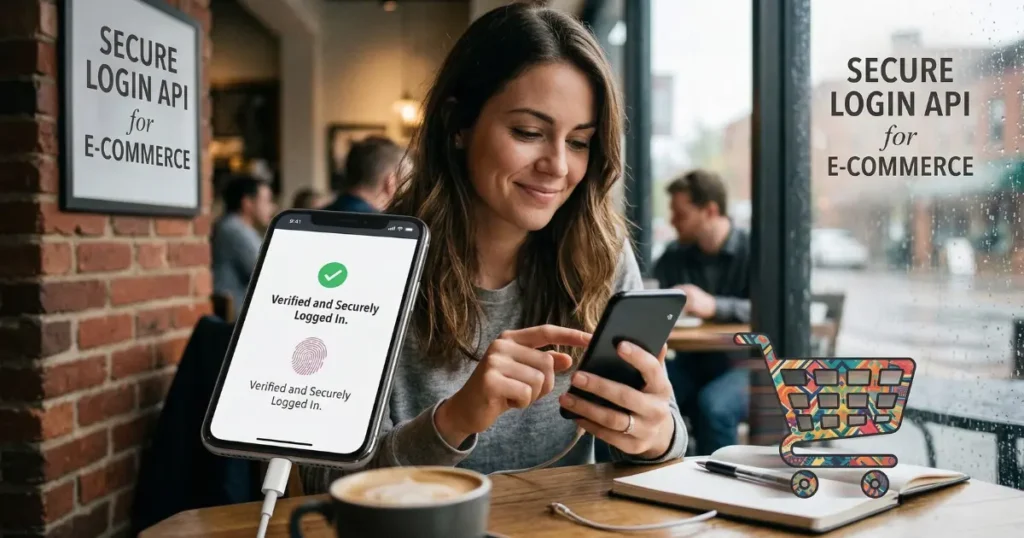
The Checkout Paradox: How to Balance Security and Sales with a Secure Login API for E-commerce
In the high-stakes world of e-commerce, there is a silent war being fought on your login page. On one side, you have the Growth Team, desperate to reduce friction, eliminate barriers, and speed users through the checkout process. On the other side, you have the Security Team, battling a rising tide of bot attacks, credential stuffing, and fraud. This conflict creates what is known as the “Checkout Paradox.” Make the login process too secure—with complex passwords, CAPTCHAs, and multi-page forms—and legitimate customers will abandon their carts in frustration. Make it too easy, and you leave the door open for cybercriminals to drain loyalty points, steal saved credit card details, and destroy your brand’s reputation. For years, online retailers were forced to choose a side. But in 2026, that binary choice is obsolete. The solution lies in modern infrastructure: specifically, a secure login API for e-commerce. This comprehensive guide will walk you through why traditional login methods are failing, the mechanics of modern authentication APIs, and how you can implement a system that protects your users without driving them away. Key Takeaways The Abandonment Crisis: The global average shopping cart abandonment rate reached a staggering 77% in 2025. Friction Costs Sales: Up to 26% of users abandon their carts simply because they are forced to create an account or navigate complex login flows. The ATO Threat: Account Takeover (ATO) fraud affected 29% of U.S. adults in the past year, with global ATO losses projected to hit $17 billion. The Solution: A modern Customer Identity Access Management (CIAM) API enables seamless Frictionless Checkout while utilizing Risk-Based Authentication to stop bots in their tracks. Transitioning to a secure login API for e-commerce allows retailers to eliminate vulnerable passwords and leverage silent mobile verification or WhatsApp 2FA. The High Cost of Friction The Psychology of the Abandoned Cart To understand why API-based logins are critical, we first need to look at user behavior. With global abandonment rates climbing above 70% across all industries, “forced account creation” and “forgotten passwords” are consistently top conversion killers. Imagine a user named Sarah. She sees an ad for a pair of sneakers on Instagram. She clicks through, selects her size, and hits “Buy Now.” Then, the wall hits: “Please Log In to Continue.” Sarah bought something from this site two years ago, but she has no idea what her password is. She tries her usual three variations. All fail. She clicks “Forgot Password,” but the reset email takes 3 minutes to arrive. By the time it lands in her inbox, the impulse to buy has faded. She closes the tab. The sale is lost. In the mobile-first era, where 79.36% of mobile carts are abandoned, patience is measured in milliseconds. Traditional username/password authentication is a conversion killer. The “Guest Checkout” Trap Many retailers try to solve this by offering “Guest Checkout.” While this reduces friction, it creates a data black hole. You lose the ability to track customer lifetime value (CLV), offer personalized recommendations, or build a loyalty program. Guest checkout solves the speed problem but kills the retention strategy. The Rising Threat of Account Takeover (ATO) While the Growth Team worries about Sarah’s lost sale, the Security Team is worried about something much darker: Prevent Account Takeover (ATO). ATO attacks occur when a fraudster gains unauthorized access to a legitimate user’s account. In Q1 2025 alone, millions of accounts were breached as cybercriminals exploited stolen credentials. Because over 62% of people reuse passwords across multiple sites, hackers use automated bots to test billions of leaked credentials against your login page—a tactic known as “Credential Stuffing.” Once inside, they can: Drain Loyalty Points: Treat accumulated points like cash to buy gift cards. Make Fraudulent Purchases: Use saved credit cards to ship high-value goods to a drop house. Resell the Account: High-status accounts are sold to other criminals on the dark web. Standard Web Application Firewalls (WAFs) struggle to stop these attacks because the bots use residential IP proxies and mimic human behavior. To the firewall, it looks like Sarah is just logging in. What is a Secure Login API for E-commerce? A secure login API is not just a pipe for checking passwords. It is a sophisticated piece of middleware that sits between your front-end store (Shopify, Magento, custom React app) and your user database. It handles the entire lifecycle of Customer Identity Access Management (CIAM). Instead of your developers writing raw code to hash passwords and manage sessions, the API abstracts this complexity. Core Capabilities: Multi-Factor Authentication (MFA): The ability to trigger an A2P SMS OTP, WhatsApp code, or Email Magic Link when a login looks suspicious.Passwordless Authentication: Eliminating the password entirely to achieve Frictionless Checkout. Risk-Based Authentication (RBA): The “brain” of the operation. The API calculates a risk score for every login attempt in real-time. Low-risk users get in instantly; high-risk attempts trigger an OTP challenge. Key Features to Look For If you are evaluating providers for a secure login API for e-commerce, do not settle for basic functionality. Here are the non-negotiable features you need to demand. 1. Latency and Uptime (The Black Friday Test) During peak traffic events like Black Friday, traffic can spike by 100x in seconds. Generic APIs often choke under this pressure. Look for a provider with Tier-1 direct carrier connections and auto-scaling infrastructure, ensuring that OTPs arrive in under 5 seconds even when network traffic is heavy. 2. Silent Mobile Verification This is the “Holy Grail” of Frictionless Checkout. Instead of sending an SMS code that the user has to read and type, the API communicates directly with the mobile carrier in the background to verify the IP and phone number. The user is logged in instantly. No typing. No codes. 3. WhatsApp Integration SMS is not reliable everywhere. A robust login API should support Verified WhatsApp out of the box. Not only is delivery faster, but the “Verified Business” green tick provides an instant trust signal to the user. The Techalpha Advantage When discussing Customer Identity Access Management