Techalpha Group Website

Connect -> Scale -> Delivered.

Author name: Nilesh

Alternatives

A2P vs P2P Messaging: Key Differences, Pros and Cons

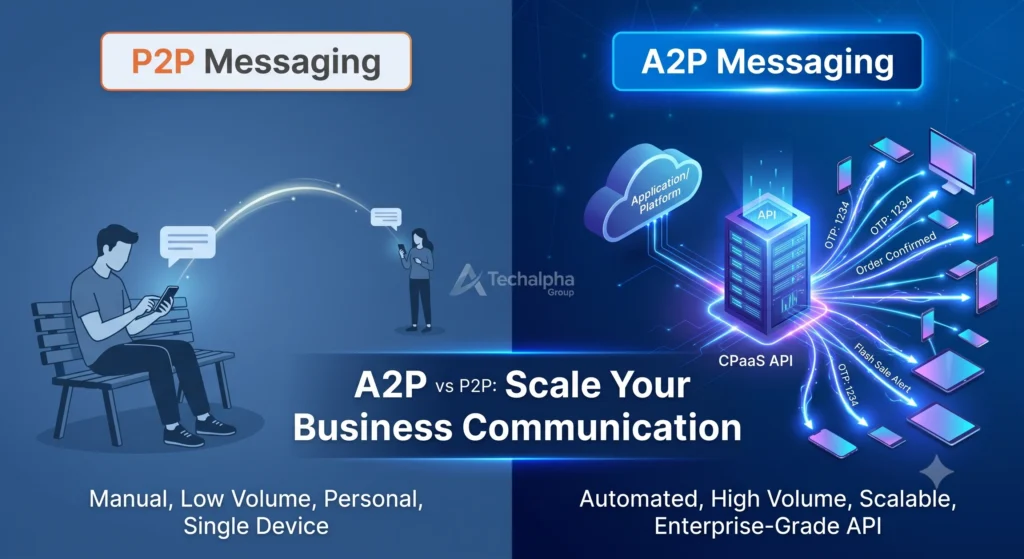
Messaging is the foundation of modern communication between businesses and customers. Banks deliver OTPs, airlines send check-in alerts, retailers run flash-sale campaigns, and healthcare providers remind patients of appointments, everything is done through messaging. There are two core models that these people use, A2P (Application-to-Person) and P2P (Person-to-Person). Both deliver texts, WhatsApp messages, or RCS updates, but their intent, scale, and regulatory obligations couldn’t be more different. This article lays out what each model means, how they differ, why regulations matter, and how businesses can make the right choice. Key Takeaways Best Use: A2P is the only viable option for enterprises sending OTPs, transactional alerts, or promotions at scale. P2P remains best for one-to-one conversations. What is A2P Messaging? A2P messaging involves businesses using applications or platforms to communicate directly with customers. Instead of a human typing a message, the system automatically sends alerts, promotions, and reminders. Examples include: A2P covers channels like SMS, WhatsApp Business API, RCS, voice, and email. For more details, see our A2P Messaging page and specific sections like SMS messaging, WhatsApp messaging, and RCS messaging. Pros of A2P Messaging Cons of A2P Messaging What is P2P Messaging? P2P messaging is personal communication between individuals. It’s what most of us use daily for conversations with friends, family, or colleagues. Examples include: For businesses, P2P is limited to small-scale interactions such as customer support chats or sales conversations (1:1human-like interactions). Learn more on our P2P Messaging page. Pros of P2P Messaging Cons of P2P Messaging A2P vs. P2P: The Key Differences Aspect A2P Messaging P2P Messaging Sender Automated via apps or software Individual users Purpose OTPs, alerts, promotions, reminders Personal or conversational use Volume High-scale, bulk campaigns One-to-one or small group chats Channels SMS, WhatsApp Business API, RCS, Email, Voice SMS, WhatsApp, personal chat apps, Personal emails Compliance Strict rules: opt-ins, registered sender IDs, approved templates Minimal restrictions; personal privacy laws apply Consent Must collect explicit opt-in and provide opt-out No formal opt-in beyond app-level permissions Security Verified senders, fraud monitoring End-to-end encryption, low compliance oversight Best For Enterprises, banks, airlines, healthcare, retail Individuals, customer support, one-to-one sales Is There a Difference in Regulations Between P2P and A2P Messaging? Yes, regulation is the single biggest dividing line, with A2P messaging being highly regulated. A2P Messaging Regulations P2P is considered personal communication, so it is lightly regulated. Carriers don’t require sender IDs or template registration, but messages are still subject to privacy and telecom laws. Abuse, like using P2P routes for spam is monitored and blocked. Bottom line: Businesses cannot avoid compliance by sending commercial messages as P2P. Carriers detect unusual traffic patterns (bulk sending, templated content) and block or penalize violators. Can Businesses Use P2P Messaging Instead of A2P to Avoid Regulations? No. This strategy backfires. Carriers use machine learning and traffic analysis to spot A2P-like behaviour on P2P routes. Offenders face: Beyond penalties, businesses lose credibility. Customers are more likely to trust verified A2P senders than messages that look suspicious. How Can Techalpha Help in A2P Messaging? Techalpha Group simplifies A2P messaging with a unified platform designed for compliance, security, and engagement. Our solutions include: Why Techalpha stands out: Conclusion A2P and P2P messaging may look similar on the surface, but their roles are entirely different. P2P is personal, small-scale, and lightly regulated. A2P is built for businesses, scalable, compliant, and trusted. Enterprises in finance, healthcare, retail, and travel cannot risk bypassing compliance. A2P is the only option for reliable, secure customer communication. With Techalpha Group they get messaging solutions which follow compliance and security measures at every point of engagement across every channel.

RCS Messaging

What is RCS Messaging – Types & Benefits 

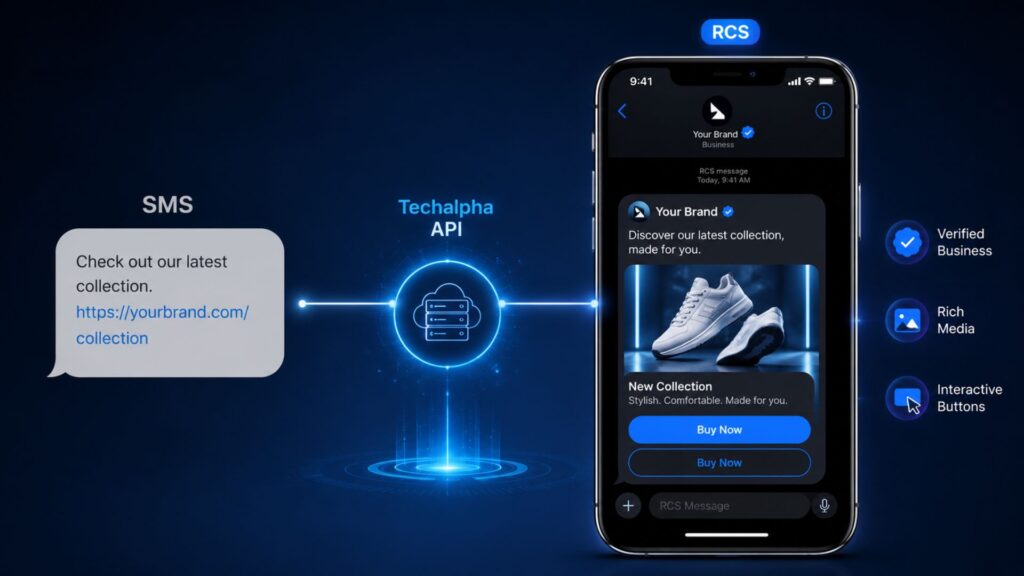
Rich Communication Services or RCS messaging modernizes mobile communication. It lets businesses send interactive messages that are complete with images, buttons and branded designs, through the messaging apps people already use.  There’s no need for app downloads and that means everything works over Wi-Fi or mobile data. This protocol is fast becoming the modern backbone of business messaging. Backed by over 1.5 billion monthly users and projected to exceed $13.1 billion in global market value by 2035, RCS messaging is on track to replace traditional SMS as the standard for customer communication. RCS delivers more than text. Brands can send: ALL without asking users to install a separate app. Customers expect smarter communication, period. Three out of four prefer brands that use modern technology, and 68% say convenience shapes what they buy. RCS delivers both. It brings SMS’s reach and modern messaging’s functionality into one frictionless, built-in channel. For brands focused on performance, this is the new standard. What Is RCS Messaging? RCS messaging is a modern messaging protocol developed by the Global System for Mobile Communications Association (GSMA) that upgrades traditional SMS with interactive features, rich media, and verified branding, without leaving the default messaging app. Unlike SMS, it runs on IP networks (4G, 5G, Wi-Fi), which allows for higher functionality without needing a separate app. Source: CB Insights It retains SMS’s universal accessibility, but with capabilities that of rival platforms like WhatsApp and iMessage. When RCS isn’t supported on a device, messages automatically fall back to SMS, ensuring delivery is never compromised. This fallback mechanism makes RCS one of the few messaging formats that blends modern features with legacy reliability. With Android commanding over 70% of global mobile market share, and Apple gradually opening RCS support, the channel’s scale is accelerating fast. For businesses, it offers a reliable, direct and interactive way to communicate with the majority of smartphone users worldwide. How RCS Messaging Works? RCS messaging runs on IP networks rather than the legacy circuit-switched infrastructure used by SMS.  Moreover, the protocol is powered by the IP Multimedia Subsystem (IMS), a 3GPP framework designed to support rich multimedia services across mobile networks. It uses Session Initiation Protocol (SIP) to establish communication sessions and Message Session Relay Protocol (MSRP) to handle the delivery of text, media and data. You might wonder about the entire process of messaging at this point. So here it is as follows. How Message Delivery Flows Here’s what happens when an RCS message is sent: Types of RCS Messages RCS messaging supports multiple formats, each built for different levels of interaction, branding and user experience. Choosing the right message type depends on your communication goal. Let’s discuss what we mean by that. 1. Plain RCS Messages These are text-first messages with light branding enhancements. Think of them as SMS, upgraded: Useful for updates, confirmations and time-sensitive alerts where rich media isn’t essential BUT brand trust still matters. 2. Rich Card RCS Message This is the most widely used format in RCS for business. It’s built to engage: Source: Techalpha Group RCS Ideal for promotions, product launches, booking confirmations, or feedback requests—anywhere multimedia and interaction matter. 3. Carousel RCS Card Carousel RCS Cards let brands send multiple interactive messages in one swipeable interface, combining images, text, and CTAs for app-like engagement. These enable dynamic, two-way messaging within a 24-hour rolling window and deliver chat-style experiences with: Source: Google Developers – RCS for Business documentation on Rich Cards. This format works best for customer service, appointment scheduling or personalized assistance, you know, where continuity drives value. Benefits of RCS Messaging RCS messaging delivers measurable performance gains. They can be better engagement, richer interactions and higher conversion rates.  Enhanced User Experience RCS blends SMS’s reach with the depth of modern messaging, with messages clocking in at 40-50%. Techalpha’s platform strengthens this further with real-time analytics, fallback delivery, and rich content engagement tracking built into the portal. In fact, RCS messages are cited to be 35× more likely to be read than email, and users are reported to spend up to 45 seconds engaging with the content. Built into the phone’s default messaging app, RCS offers typing indicators, read receipts, carousels and interactive buttons. I mean these are literally the hallmarks of modern chat, which are now wired into business messaging. Verified Business Communication RCS doesn’t leave trust to chance. Verified business messages come stamped with carrier-authenticated logos, names, and branding, all embedded directly into the conversation thread. Spoofing? Off the table. Source: Techalpha Group RCS It’s part of a broader fraud-prevention layer, where carriers verify senders before delivery, giving businesses especially in banking, healthcare, and e-commerce, a trusted pipeline to the user’s phone. Superior Engagement Metrics The numbers are where RCS pulls ahead. Interactive messages drive 4x higher engagement than SMS and campaigns routinely hit conversion rates up to 50%. In terms of ROI, some businesses have reported a 1633% increase over standard messaging methods. Built-in analytics complete the loop. Businesses can track delivery status, read receipts, button clicks and more.  Does RCS Messaging Use Data? Yes, RCS uses data (Wi-Fi or mobile data) to send messages, similar to internet-based messaging apps like WhatsApp or iMessage. RCS messages are sent over a Wi-Fi or mobile data connection, similar to other internet-based messaging apps. They do not use the traditional cellular network used for standard SMS messages. Here’s how data usage works: Fallback to SMS: If you don’t have an active data connection (either Wi-Fi or mobile data), or if the recipient does not support RCS, the message can be automatically sent as a traditional SMS or MMS message. Standard SMS messages use the cellular network and do not count against your data plan, but they may have per-message costs depending on your plan. How Techalpha Can Help You with RCS Messaging Techalpha is India’s go-to CPaaS (Communication Platform as a Service) provider for brands that want RCS messaging done right.  From infrastructure to delivery, compliance to performance, we offer a full-stack solution designed to give businesses

a2o messaging
A2P Messaging

7 Best A2P Messaging Software for 2025

A2P messaging has evolved from one-way SMS alerts into a central part of customer engagement. Today, it is how brands build trust, reduce friction, and deliver instant updates and market themselves. Just like how Uber uses A2P to confirm rides and connect drivers and passengers securely, or how Amazon relies on it for order updates and delivery alerts. These are touchpoints that define customer experience at scale. As industries like finance, healthcare, retail, and travel adopt richer formats across WhatsApp, RCS, email, voice, and AI chatbots, the demand for reliable and scalable A2P platforms has never been higher. Key Takeaways How We Evaluated the Best A2P Messaging Software To rank the top providers, we looked at five criteria that matter most for businesses in 2025: 1. Techalpha Group Techalpha Group delivers an end-to-end CPaaS suite designed to unify all customer communications. Its platform covers SMS, WhatsApp Business API, RCS, email, voice calls, and AI-powered chatbots, enabling businesses to run campaigns and critical alerts from a single dashboard. Key Features Best For Enterprises that want one partner for all customer messaging needs. Why It Stands Out Techalpha Group tops this list for aligning its multi-channel platform with the compliance and engagement needs of regulated industries. 2. Twilio Twilio is one of the best-known names in global communications, trusted by enterprises across every sector. Its strength lies in flexible APIs that give developers the power to build custom messaging, voice, and video applications at scale. Key Features Best For Enterprises building custom global communication solutions. Why It Stands Out Twilio’s flexibility and global scale make it the go-to for businesses that want to design their own communication stack. 3. Vonage Vonage has long been associated with enterprise communications and, under Ericsson, has strengthened its CPaaS capabilities. The company combines messaging, voice, and video services to provide a complete communication toolkit for global businesses. Key Features Best For Large enterprises with complex communication requirements. Why It Stands Out Vonage blends messaging, voice, and video into a unified enterprise solution. 4. Infobip Infobip is one of the largest CPaaS providers in the world, operating through direct partnerships with mobile operators in more than 190 countries. Its platform supports large-scale enterprise needs with omnichannel messaging and strong compliance features. Key Features Best For Multinational enterprises requiring consistent global delivery. Why It Stands Out Infobip’s carrier-grade infrastructure ensures reliable and compliant reach worldwide. 5. Gupshup Gupshup is India’s leading conversational messaging provider, serving both large enterprises and startups across Asia. Its dominance in WhatsApp Business APIs and chatbot deployments has made it a preferred partner for customer engagement at scale. Key Features Best For Brands designing WhatsApp-led customer journeys. Why It Stands Out Gupshup dominates WhatsApp messaging in Asia, making it a top choice for customer engagement in the region. 6. Kaleyra Kaleyra has built a strong reputation in banking, healthcare, and other regulated industries. It offers secure and compliant workflows while maintaining global connectivity across SMS, WhatsApp, and RCS channels. Key Features Best For Businesses in regulated industries such as finance and healthcare. Why It Stands Out Kaleyra places compliance and data security at the core of its offering. 7. MessageBird MessageBird, based in the Netherlands, brings automation and customer support tools together in one platform. It is particularly strong in Europe, where it supports enterprises and SMBs with easy-to-use APIs and workflow builders. Key Features Best For SMBs and enterprises in Europe seeking automation-friendly tools. Why It Stands Out MessageBird combines automation workflows with unified support to simplify operations. Comparison of All the Best A2P Messaging Software Provider Channels Supported Key Strength Best For Techalpha Group SMS, WhatsApp, RCS, Voice, Email, Chatbot Industry focus Regulated industries Twilio SMS, WhatsApp, Voice, Email, Video Developer ecosystem Global enterprises Vonage SMS, Voice, Video, APIs Enterprise integration Large enterprises Infobip SMS, WhatsApp, RCS, Email, Push Global coverage Multinational firms Gupshup SMS, WhatsApp, Chatbots Conversational AI India and Asia markets Kaleyra SMS, WhatsApp, RCS Compliance focus Finance and healthcare MessageBird SMS, WhatsApp, Email, Voice Automation workflows EU-based businesses Conclusion The A2P messaging ecosystem has become a backbone of enterprise communication. While Twilio and Infobip dominate global coverage, and regional players like Gupshup and Kaleyra serve targeted needs, Techalpha Group distinguishes itself with an industry-first, multi-channel approach. There are a lot of other Twilio alternatives that you should be looking for as well. For businesses entering 2025, Techalpha Group is the starting point for building secure, scalable customer engagement.

Alternatives

7 Best Twilio Alternatives for 2025

Twilio has long been the go-to platform for businesses building global communication systems. Its APIs power SMS alerts, WhatsApp messages, voice calls, and more for companies across the world. But as the CPaaS market has grown, many businesses have started looking for alternatives. Why? Rising costs, complex integrations, regional pricing differences, and compliance requirements often make Twilio less practical for certain industries. Banks may need stronger compliance coverage, retailers might prefer WhatsApp-first solutions, and healthcare providers often demand secure and localized communication flows. That’s why alternatives are gaining ground in 2025. In this article, we break down seven top providers that match or exceed Twilio in areas like compliance, pricing flexibility, automation, and regional dominance. Key Takeaways Why Businesses Look for Twilio Alternatives Twilio remains powerful, but businesses increasingly evaluate other providers for these reasons: How We Evaluated Alternatives Each provider was assessed using five criteria: 1. Techalpha Group Techalpha Group provides a full CPaaS suite designed to unify enterprise communication. Its platform includes SMS, WhatsApp Business API, RCS, voice calls, email, and AI chatbots, all managed from a single interface. Key Features Best For Enterprises that need compliance-ready, industry-specific communication tools. Why It Stands Out Techalpha Group puts regulated industries at the center of its platform. Its multi-channel and compliance-first approach makes it the best Twilio alternative for enterprises that cannot compromise on security and scale. 2. Infobip Infobip is one of the largest CPaaS providers worldwide, serving businesses in 190+ countries. With direct carrier partnerships, it ensures high delivery rates and consistent performance at scale. Key Features Best For Multinational enterprises seeking global coverage with strong local compliance. Why It Stands Out Infobip’s direct carrier network and broad coverage make it ideal for businesses operating in multiple regions. 3. Sinch Sweden-based Sinch is known for its voice and verification services alongside messaging. It works with telecom operators worldwide and supports enterprise-scale needs. Key Features Best For Enterprises that need strong voice and verification capabilities in addition to messaging. Why It Stands Out Sinch’s focus on verification and identity makes it a solid alternative for businesses needing secure and trusted communications. 4. Vonage Vonage, now part of Ericsson, offers a complete enterprise communication stack. It combines messaging, voice, and video into a flexible platform for large organizations. Key Features Best For Large enterprises that need integrated communication tools beyond messaging. Why It Stands Out Vonage’s ability to blend video, voice, and messaging makes it a versatile choice for enterprises. 5. Gupshup Gupshup leads the WhatsApp Business API market in India and Asia. It also offers chatbots and conversational AI, helping brands deliver interactive customer experiences. Key Features Best For Businesses building WhatsApp-first customer journeys. Why It Stands Out Gupshup’s dominance in WhatsApp makes it the go-to choice for conversational marketing in Asia. 6. Kaleyra Kaleyra is a compliance-first CPaaS provider that serves banks, fintechs, and healthcare companies globally. It prioritizes secure workflows and strict industry standards. Key Features Best For Regulated industries such as finance and healthcare. Why It Stands Out Kaleyra’s emphasis on compliance and secure messaging sets it apart as a Twilio alternative for regulated enterprises. 7. MessageBird MessageBird, headquartered in the Netherlands, simplifies enterprise communications with automation and customer support tools. Its Flow Builder and Inbox make it accessible for both SMBs and large companies. Key Features Best For SMBs and enterprises in Europe seeking automation-friendly tools. Why It Stands Out MessageBird combines automation with customer support, offering businesses efficient workflows. Complete Comparison of Best Twilio Alternatives Provider Channels Supported Key Strength Best For Techalpha Group SMS, WhatsApp, RCS, Voice, Email, Chatbot Compliance-ready, industry focus Regulated enterprises Infobip SMS, WhatsApp, RCS, Email, Push Global coverage Multinational firms Sinch SMS, Voice, Verification, Video Identity and voice focus Enterprises needing verification Vonage SMS, Voice, Video, APIs Enterprise integration Large enterprises Gupshup SMS, WhatsApp, Chatbots Conversational AI Asia and India markets Kaleyra SMS, WhatsApp, RCS Compliance focus Finance and healthcare MessageBird SMS, WhatsApp, Email, Voice Automation workflows EU-based businesses Conclusion Twilio remains a leader in CPaaS, but it’s not always the best fit for every business. Rising costs, complex integrations, and compliance needs often push enterprises to look for alternatives. Global providers like Infobip and Sinch excel in scale, Gupshup leads in WhatsApp-first engagement, and Kaleyra wins on compliance. But for enterprises that need a secure, multi-channel solution tailored to industries like finance, healthcare, and real estate, Techalpha Group is the strongest Twilio alternative in 2025.

Email Marketing
Email Marketing

7 Best Email Marketing Services for 2025

Email remains the highest-return digital channel in 2025, delivering $36–$42 ROI for every $1 spent. Each day, more than 347 billion emails are sent, and 81% of SMBs rely on email as their main acquisition tool. Ofcourse, the industry has matured far beyond newsletters.  Modern email marketing tools now use AI-driven personalization, multi-step automation, and analytics comparable to CRMs. With 65% of opens on mobile, responsive design is non-negotiable. That said, the “best” platform depends on your growth stage, industry and the kind of customer journey you want to design. We evaluated 35+ platforms using a strict multi-step process to filter out hype and identify true performance leaders. The screening criteria included: As ActiveCampaign CEO Jason VandeBoom put it, “At the end of the day, we don’t want any two of our clients to have the same experience.” That philosophy was central to our evaluation in actually measuring how well each platform supports personalized journeys rather than just blasting emails. 7 Best Email Marketing Services 1. Techalpha Group – Best Overall Techalpha Group has built a reputation as a full-scale CPaaS provider that goes well beyond email. Its strength lies in combining traditional SMS scale with modern multi-channel tools such as WhatsApp Business API, RCS, email campaigns, and AI chatbots, yes, all under one roof. Who It’s For Some of the standout features worth knowing are Pros and Cons of Techalpha Pros Cons Proven track record with 95% retention and 300+ projects. No free trials or sandbox environments for developers. A comprehensive multi-channel suite eliminates the need for multiple vendors. Industry-specific solutions for Finance, Healthcare, and Real Estate. 24/7 support and dedicated account management. 2. ActiveCampaign  If there’s one platform that proves email marketing tools can feel like a full-fledged growth engine, it’s ActiveCampaign.  The platform’s 900+ automation templates and visual builder let you map out campaigns that adapt in real time to how people behave. So you know whether they’re browsing a product page, abandoning a cart or moving through a long B2B pipeline you have an ultimate tool to customize everything. Who It’s For Pros and Cons of ActiveCampaign Pros Cons Best-in-class automation flexibility Steeper learning curve than beginner platforms Built-in CRM keeps sales and marketing aligned Costs escalate with list size Deliverability tested at 98.7% Template design library could be more polished 870+ integrations for smooth stack connections Support can lag during peak times 3. MailerLite – Best Value for Small Businesses If email marketing had a “no-frills, gets-it-done” champion, it would be MailerLite.  It’s the rare platform where the free plan is actually usable. Yep! That has 1,000 subscribers, 12,000 monthly sends and automation included. Ofcourse, that’s enough for most small businesses to run real campaigns without paying a dime. We think that what makes MailerLite appealing is actually the simplicity. The interface is clean, the drag-and-drop editor feels intuitive and the platform doesn’t bury core features behind enterprise walls.  Who It’s For Source: MailerLite Pricing Page Pros & Cons of MailerLite Pros Cons Free plan strong enough for real campaigns Automation depth lags behind ActiveCampaign Deliverability tested at 97.2% Smaller integration ecosystem (100+ vs 800+) Website + landing page builder included Reports are fairly basic Smooth, minimal interface. Super ideal for beginners No phone support 30% nonprofit discount Limited template library 4. Klaviyo – Best for E-commerce To be honest, Klaviyo has become the default email campaign software for online stores and 2025 hasn’t changed that but wait let us tell you that its new pricing has stirred the pot.  Who It’s For Shopify, WooCommerce, BigCommerce – if you run one of these, Klaviyo is usually the first tool recommended. Why? Because it doesn’t just send emails, it builds data-rich customer profiles and turns them into revenue. Klaviyo’s billing overhaul in 2025 made waves.  Instead of charging by sends, they now use active profile billing. It means every subscriber in your database counts toward your bill, even if you haven’t emailed them recently. Yes, that’s right! On top of that, the system auto-upgrades your plan the moment you cross a contact threshold. It’s designed for fast-growing brands, but it can feel punishing if your list isn’t clean or well-managed. But listen here’s the trade-off! You’re paying for the ability to run data-driven, revenue-focused campaigns. So, abandoned carts, browse recovery, predictive lifetime value scores. For stores with healthy margins, the cost is often worth it. For brands with bloated or inactive lists, though, Klaviyo’s model can quickly eat into ROI. That trade-off is why Klaviyo still earns its place among the top email marketing platforms today. Pros & Cons of Klaviyo Pros Cons Best-in-class for e-commerce integrations Costs rose sharply in 2025 Customer data platform unifies purchase + behavior history Pricing model can lead to surprise bills Predictive analytics + AI-driven recommendations Support limited (no phone) Revenue attribution tied directly to campaigns Templates less flexible than expected 98.1% deliverability Learning curve for non-technical teams 5. Mailchimp Believe it or not but Mailchimp is still the heavyweight of best email marketing, even with its steeper price tag.  So as per our Techalpha experts what keeps it on top is its ability to run everything in one place you know – you get social ads, postcards, a website builder and 600+ integrations, all managed from one place. Who It’s For For established businesses and agencies managing multiple brands, that all-in-one setup is worth the premium. One of the main reasons for Mailchimp being in one of the top 6 best email marketing services is that its audience insights remain a standout.  Mailchimp can do much much more than mere segment by opens; it predicts demographics, purchasing patterns and long-term value. Its ‘Creative Assistant’ also makes brand consistency easier across campaigns, from emails to social posts. Also, the amazing part is its revenue attribution tools show exactly how campaigns tie back to purchases. Pros & Cons of Mailchimp Pros Cons Most comprehensive toolset on the market More expensive than most competitors, especially at scale Excellent deliverability (97.8% in

OBD IVR Solution
IVR Solutions

Top 10 IVR Solutions for 2025

Interactive Voice Response (IVR) systems have become essential for modern businesses looking to increase efficiency in customer service,  reduce operational costs, and provide 24/7 automated support.  How We Chose These IVR SolutionsWhile creating this list, we took into consideration several factors: These criteria ensured we compared providers on real business impact, not just marketing claims Here’s a comprehensive guide to the top 10 IVR solutions that stand out in 2025. 1. Techalpha’s OBD IVR Techalpha’s Outbound Interactive Voice Response (OBD) system leads our list as a specialized solution designed for automated customer outreach with interactive capabilities. As customers of Techalpha saw 50% improvement in response time. Key Features: Best For: Businesses requiring automated outbound calling campaigns with interactive voice responses, particularly for customer surveys, payment reminders, promotional campaigns, and appointment confirmations. 2. Nextiva Nextiva IVR provider with its AI-powered system and comprehensive communication platform. Key Features: Best For: Businesses looking for a comprehensive communication platform with advanced IVR, AI capabilities, and a focus on customer experience. 3. Five9 Five9 excels in contact center integration with intelligent routing and flexible IVR functionality. Key Features: Best For: Large call centers that benefit from flexible IVR functionality and comprehensive contact center features across multiple channels. 4. Genesys Cloud Genesys Cloud provides the best NLP-based IVR system with conversational AI capabilities. Key Features: Best For: Enterprises requiring sophisticated AI-powered IVR solutions that feel human and can handle complex customer interactions. 5. Talkdesk Talkdesk offers exceptional customization with its drag-and-drop Studio designer. Key Features: Best For: Support-heavy teams aiming to improve customer journeys without overcomplicating setup, particularly those who value ease of use without losing customization power. 6. NICE CXone NICE CXone provides the best traditional IVR service with reliable self-service options. Key Features: Best For: Businesses needing a customizable, traditional IVR service provider that scales reliably and handles standard self-service use cases. 7. Twilio Flex Twilio offers the most developer-friendly IVR solution with maximum customization flexibility. Key Features: Best For: Developer-focused teams and businesses requiring maximum customization and flexibility in their IVR implementation. 8. Dialpad Dialpad excels in AI-driven IVR with advanced analytics and outbound call automation. Key Features: Best For: Businesses seeking AI-driven IVR solutions with advanced analytics, outbound capabilities, and forward-facing AI features. 9. Avaya Avaya provides enterprise-class IVR solutions designed for large-scale, multinational operations. Key Features: Best For: Large enterprises and multinational corporations requiring scalable IVR solutions with an extensive multi-language support. 10. RingCentral RingCentral rounds out our list as the best solution for large businesses needing comprehensive communication features. Key Features: Best For: Large businesses requiring a comprehensive communication platform with advanced IVR features and strong integration capabilities. Choosing the Right IVR Solution When selecting an IVR system for your business, consider these key factors: The options for IVR solutions in 2025 offer sophisticated solutions all the way from specialized outbound systems like Techalpha’s OBD IVR to comprehensive enterprise platforms. Each solution brings unique strengths, making it essential to align your choice with your specific business needs, technical requirements, and growth objectives. The choice is yours and to your needs. 

P2P Messgaing

Understanding P2P Messaging: Everything You Need to Know

If the world is powered by data, then it’s not just what you collect, it’s also what and how you communicate that creates real value. As businesses race to optimize customer journeys and support systems, one channel stands out for its trust, simplicity and responsiveness. Person-to-person (P2P) messaging continues to outperform others, especially in marketplaces and customer engagement. What Is P2P Messaging ?  P2P messaging refers to direct communication between two mobile service users/ subscribers without automated systems in the flow. It’s most often delivered via SMS (Short Message Service) or chat apps like WhatsApp or iMessage. Each message starts as an MO (Mobile Originated) message when sent from the sender’s device and becomes MT (Mobile Terminated) when received on the recipient’s device. Together, MO and MT form the complete P2P cycle. The Sender ID in this context is typically a long code like a regular 10-digit number representing a real person, not a brand or platform. Unlike A2P systems, where a server sends messages in bulk, P2P messaging is built around individual peer interactions, usually via long codes routed through a user’s home network (the MNO or Mobile Network Operator). Components of P2P Messaging  While it looks as the most simplest form of communicating, there are multiple components operating with it under the hood. Advanced networks may use messaging protocols like SMPP (Short Message Peer-to-Peer) to route SMS between SMSC (Short Message Service Centers). However, in traditional P2P, this layer is often invisible to the end user. How does P2P Messaging Work? P2P (Person-to-Person or Peer-to-Peer) messaging is about direct, human conversation. Whether it’s a customer texting a support rep, a buyer reaching out to a seller, or a rider messaging their delivery driver. These are real interactions that shape customer experience and brand perception. Now that we know what’s under the hood, let’s understand the process. 1. Message Composition A user opens their messaging app (such as SMS, WhatsApp, or another chat platform) and composes a message. The sender manually enters the recipient’s phone number or selects a contact from their address book. 2. Message Submission Once composed, the sender hits “send.” The message is transmitted from the sender’s device to their mobile network operator (MNO) or the internet, depending on the platform. 3. Routing Through the Network The mobile network operator (for SMS) or the messaging service provider (for chat apps) receives the message and determines the best route to deliver it to the recipient. For SMS, this involves routing through the appropriate Short Message Service Center (SMSC) and possibly interconnecting with other networks if the recipient is on a different carrier. 4. Delivery to Recipient’s Device The message is delivered to the recipient’s device via their MNO or through the internet if using an over-the-top (OTT) app. The recipient is notified of the new message, typically through a push notification or alert. 5. Read and Response The recipient reads the message and, if desired, composes a reply. The process then repeats, enabling real-time, two-way communication. 6. Optional: Delivery Confirmation Many platforms provide a delivery receipt or read receipt, confirming to the sender that the message has been delivered or read by the recipient. This process of P2P maintains that messaging always remains direct, personal, and conversational with each step requiring genuine human interaction. The method is designed for simplicity and immediacy, making it ideal for authentic, real-time exchanges. How P2P, A2P, and P2A Are Different Feature P2P (Person to Person) A2P (Application to Person) P2A (Person to Application) Sender Human Application or Platform Human Recipient Human Human Application or System Use Case Direct conversations Alerts, OTPs, offers Voting, subscriptions Message Path MO to MT Usually MT only MO only Sender ID Long Code Short Code / Branded ID Long Code / Keyword-based Rules Fewer Strictly regulated Depends on region Understanding these definitions helps businesses avoid misusing grey routes or unofficial channels often used to bypass restrictions. Grey routing may temporarily lower costs but risks non-compliance, poor delivery, and reputation damage. Global Compliance and Local Differences In North America, only handset-to-handset messages over long codes are classified as P2P. Anything passing through a messaging API or sent via platform is automatically A2P, even if conversational in tone. In Europe and parts of Asia, there’s more flexibility. Some systems allow messages sent via APIs to still qualify as P2P if the exchange is genuinely two-way and not commercial in nature. Across markets, delivery receipts (DLRs) help businesses confirm that messages reach the intended device. This is key for time-sensitive support or logistics messages sent via P2P routes. How P2P Messaging Is Used Today P2P messaging is not something invented in the last 1 or 2 years, real-world businesses are already based on P2P messaging channels. These communications rely on long codes, direct routing, and minimal system involvement, making them feel natural and reliable. How Tech Alpha Group Supports P2P Messaging Techalpha Group helps businesses move away from risky P2P messaging practices and adopt secure, scalable A2P messaging solutions. Grey routes used in P2P may reduce short-term costs but expose businesses to compliance issues, failed delivery, and reputational risk. If you’re looking to engage users via messaging, A2P is the better alternative: Techalpha’s A2P platform is built for the best compliance, performance, and long-term growth. FAQs 1). Is P2P messaging legal for business or campaign use? P2P messaging is legal for business or campaign use as long as each message is sent through genuine human intervention. It’s important to comply with regulations like the TCPA and FCC in the U.S., which distinguish between manual and automated messaging. Manual sending helps avoid stricter rules that apply to automated (A2P) messages. 2). What are the main benefits of using P2P messaging? The main benefits of P2P messaging include higher engagement and response rates, often exceeding 90% open rates. It allows for real-time, two-way conversations and personalized interactions at scale. P2P messaging also avoids many restrictions placed on bulk or automated communications, making it effective for direct outreach. 3). How is

RCS Messaging, SMS Messaging

SMS Vs RCS: Understanding SMS and RCS Messaging And What’s Best for Your Business.

In a mobile-first digital economy, how businesses communicate with their customers can determine the difference between engagement and abandonment. Whether it’s a real-time transaction alert or an interactive marketing campaign, mobile messaging remains the most direct channel available today. Two primary technologies lead the space, SMS (Short Message Service) and RCS (Rich Communication Services). SMS has been a dependable workhorse since the 1990s, while RCS, sometimes referred to as “SMS 2.0,” is the modern upgrade with multimedia, branding, and interactivity baked in. But how do these technologies compare for business messaging, and what should your company use? In this article, we  will take a look at the differences between SMS and RCS and the benefits they offer to different businesses.  Let’s begin. What Is SMS? SMS is a cellular messaging protocol that allows the transmission of short text messages of up to 160 characters between devices. It operates over telecom signaling networks, meaning it does not require an internet connection, and can deliver messages in even the most bandwidth-constrained areas. How SMS Works: Despite its simplicity, SMS remains the most used tool in A2P messaging (Application-to-Person), especially for delivering OTPs, appointment reminders, order confirmations, and time-sensitive alerts. What Is RCS Messaging? Rich Communication Services (RCS) is a next-gen messaging protocol developed by the GSMA. It transforms traditional messaging into an immersive communication channel, allowing businesses to send: How RCS Works: RCS messages are IP-based. They require: Where RCS is unsupported, the message automatically falls back to SMS or MMS, ensuring consistent delivery. SMS for Business: Still Relevant in 2025 Business SMS is one of the most trusted and direct A2P messaging tools. It continues to dominate transactional communication due to its reach, speed, and cost-effectiveness. Key Benefits: 98% open rate within minutes  According to MobileSquared (2021), SMS messages are opened within three minutes on average, making it one of the most effective communication channels for urgent or time-sensitive notifications. Works without the internet  SMS operates on cellular networks, making it a reliable solution in remote locations, during outages, or in low-bandwidth environments—ideal for reaching customers where mobile apps or emails might fail. Flexible with multiple number types  SMS works seamlessly with short codes for marketing blasts, long codes for two-way interactions, and toll-free numbers for branded customer service lines—giving businesses the flexibility to tailor messaging based on context. Supports critical business functions  From OTP delivery to real-time alerts, order tracking, and survey distribution, SMS offers the versatility needed to power everything from security workflows to customer experience touchpoints. Simple integration via API   Modern platforms like TechAlpha offer plug-and-play SMS APIs that connect easily with your CRM, e-commerce system, or help desk—so you can start messaging at scale without overhauling your tech stack. While SMS lacks branding and interactivity, it excels in reliability and simplicity and thus making it indispensable for mission-critical communication. RCS for Business: The New Frontier in Messaging RCS Business Messaging (RBM) enables enterprises to deliver branded, visual, and interactive experiences directly to customers through their phone’s native messaging app. Key Features of RCS for Business: Verified Sender ID Build immediate trust with messages that include your brand name, logo, and verified business identity. Unlike anonymous SMS numbers, RCS lets customers instantly recognize who the message is from and reduces unnecessary friction and increases engagement. Media-Rich Messages RCS supports a wide range of file types—high-quality images, videos, GIFs, PDFs, and even QR codes. Whether you’re sending a product showcase, onboarding video, or a downloadable brochure, RCS helps you deliver content that grabs attention and adds value. Interactive Carousels and Suggested Replies  Guide customer journeys within the message itself. Use swipeable carousels to showcase products or services, and add buttons like “View Demo,” “Track Order,” or “Get Support” that lead to instant action—no app or browser needed. Analytics That Matter Go beyond basic delivery receipts. With RCS, you get real-time insights into who viewed your message, which buttons they clicked, and when. These metrics allow you to refine campaigns based on actual user behavior—just like you would with email or web traffic. Trust Indicators and Business Authentication All RCS business messages are sent from verified profiles, minimizing the risk of spam or phishing. Customers see a verified badge, giving them confidence that the message is legitimate and safe to interact with. With TechAlpha’s RCS API, businesses can deploy these rich messaging campaigns without complex setups and reach users at the right time, in the right format. RCS vs SMS: A Feature Comparison Feature SMS RCS Media Support Text only (160 chars) Images, videos, PDFs, carousels Branding No Yes (logo, business name, verified sender ID) Internet Required No Yes Interactivity Limited (shortcodes) High (buttons, replies, forms) Global Reach Universal Growing but limited to supported devices/networks Security Basic Sender verification, optional encryption Analytics Basic delivery status Detailed engagement tracking Use in Messaging Campaigns Simple alerts Interactive campaigns with CTAs Integration SMS API RCS API with fallback via SMS (e.g., TechAlpha) A2P Messaging: Why It Matters A2P messaging (Application-to-Person) refers to automated texts sent from a business application to individuals. Both RCS and SMS fall under this umbrella and are often used for: Compared to P2P messaging (person-to-person), A2P is governed by telecom compliance rules like the Telephone Consumer Protection Act (TCPA) and requires registration of messaging campaigns. Platforms like TechAlpha simplify campaign vetting and registration with carriers. Short Code, Long Code, Toll-Free: Choosing the Right Number Type When it comes to business messaging, the type of number you use can also have an impact on deliverability, throughput, brand recognition, and compliance. Whether you’re sending transactional alerts, marketing promotions, or customer service updates, choosing between a short code, long code, or toll-free number is a strategic decision.  Each option serves a different purpose and fits different business models. Let’s break down what each number type offers so you can choose the right fit for your goals. Short Code: Long Code: Toll-Free Numbers: With TechAlpha, you can register and manage short codes, long codes, or toll-free numbers through a unified dashboard. Which

A2P Messaging

A2P Messaging Explained, Its Benefits & A2P Messaging Channels

Customers expect fast, clear updates from the brands they trust. They want messages that are timely and reliable. When someone makes a payment or signs in, they expect a response within seconds. Slow or missed messages can damage trust and hurt business results. Manual communication can’t meet this demand anymore and growing businesses always need scale, speed and consistency in every interaction. A2P messaging solves this challenge. In this article, we’ll explain what A2P messaging is, how it works, and where it fits best. We’ll cover its benefits, common use cases, channels and how Tech Alpha Group creates modern messaging. Let’s begin by understanding what A2P messaging actually means. What is A2P Messaging? Application-to-Person (A2P) messaging is the process of automatically sending SMS or MMS messages to specific customers from an application, usually utilised by enterprises.  These messages are automated and often transactional or promotional. A2P messaging is used by banks, e-commerce platforms, healthcare providers, and many others. Unlike P2P texting, A2P is not personal or manual. It is structured for high volume and reliability. It’s built to send thousands of messages at once and still deliver within seconds. Telecom rules govern this traffic to ensure safety and trust. Every alert, confirmation, or offer you receive from a brand is likely A2P messaging. It keeps users informed and businesses connected. Let’s look deeper at how this process works from start to finish. How Does A2P Messaging Work? A2P messaging starts with a system trigger. A user signs in, places an order or books an appointment. This action tells the backend software to send a message. The message request goes through a messaging platform like Tech Alpha’s A2P Messaging platform. A snapshot of what an A2P Messaging platform looks like The provider connects with telecom networks. It routes the message based on location, format, and rules. The mobile carrier then delivers it to the end user.  This happens almost instantly. Some messages allow replies. Others are one-way only. A2P platforms support both and offer tracking, reporting, and routing options. Now that you understand how it works, let’s compare it with P2P messaging to see what makes A2P unique. What is the Difference Between A2P vs P2P Messaging? P2P stands for person-to-person messaging. It’s what we use daily with friends, family, and coworkers. These messages are sent manually and in small numbers. No business systems are involved. A2P works differently. Here, the sender is an application. It messages many users automatically and follows strict rules. Businesses must register their messaging use and brand identity. The key difference lies in scale, compliance, and automation. A2P is for structured business use while P2P is for everyday chats. Want the full feature-by-feature breakdown? We have a detailed guide on A2P vs P2P messaging guide. With that difference clear, let’s dive into the direct benefits of using A2P messaging. Direct Benefits of A2P Messaging Before diving into the technicals, it’s worth noting why so many businesses rely on A2P messaging in the first place. The advantages are not just theoretical—they’re practical, proven, and directly tied to performance metrics that matter. Here’s what sets A2P apart: Beyond Basic Delivery: The Strategic Advantage of A2P While A2P messaging offers clear benefits—speed, reliability, and reach—its strategic value extends deeply into a business’s operations and customer relationships. It’s not just about sending messages; it’s about optimizing the entire customer journey and internal workflows. Consider the cost efficiencies. Automating routine communications like appointment confirmations or payment reminders significantly reduces the need for manual outreach. This frees staff for more complex customer service issues. Operational streamlining directly translates into reduced labor costs and improved resource allocation.  High deliverability and open rates for A2P messages also mean a much better return on investment compared to traditional marketing channels, where messages often go unread or undelivered. A2P messaging builds strong customer relationships. Timely delivery of crucial information, whether a security alert or a shipping update it creates trust and transparency.  Customers feel valued and informed, leading to higher satisfaction and loyalty. This proactive communication can even prevent customer inquiries, reducing the load on support centers and enhancing the overall customer experience.  In a time of rising customer expectations, using A2P messaging is a norm for higher engagement, lesser churn and an ultimate sustainable business growth. It turns communication from a simple exchange into a powerful tool for strategic advantage. Common Use Cases for A2P Messaging A2P messaging powers many parts of business communication. From banking to e-commerce, it covers a wide range of needs.  Here are some of the most popular use cases: 1. Two-Factor Authentication and OTPs Users get a one-time passcode to log in or approve payments. It keeps accounts secure and transactions safe. 2. Appointment Reminders Clinics, salons, and service providers remind users of scheduled visits. This reduces no-shows and improves operations. 3. Transaction and Bank Alerts Banks send real-time messages about account activity. These alerts include withdrawals, logins, or failed payments. 4. Marketing Campaigns and Promotions Brands use A2P to send deals, sales alerts, and event invites. These messages are often personalized and time-sensitive. 5. Shipping and Delivery Notifications Retailers keep buyers updated on their order status. This includes dispatch, delivery time, and receipt confirmations. 6. Customer Surveys and Feedback Requests After service, businesses ask for quick feedback. This helps improve services and understand customer sentiment. Each of these use cases shares one thing: they rely on speed, clarity and automation. That’s what A2P does best. To make the most of these, businesses choose the right messaging channels. Let’s explore those next. Some of the Channels of A2P Messaging A2P messaging isn’t limited to SMS. Businesses now use several channels, each suited for different types of interactions. The right channel depends on your use case, customer habits, and message type. Many brands start with SMS, then expand as their needs grow. About Tech Alpha Group Tech Alpha Group builds communication systems that work in real time. We help businesses send messages that matter. Whether it’s a reminder, alert, or

Scroll to Top

DOWNLOAD E-BOOK