
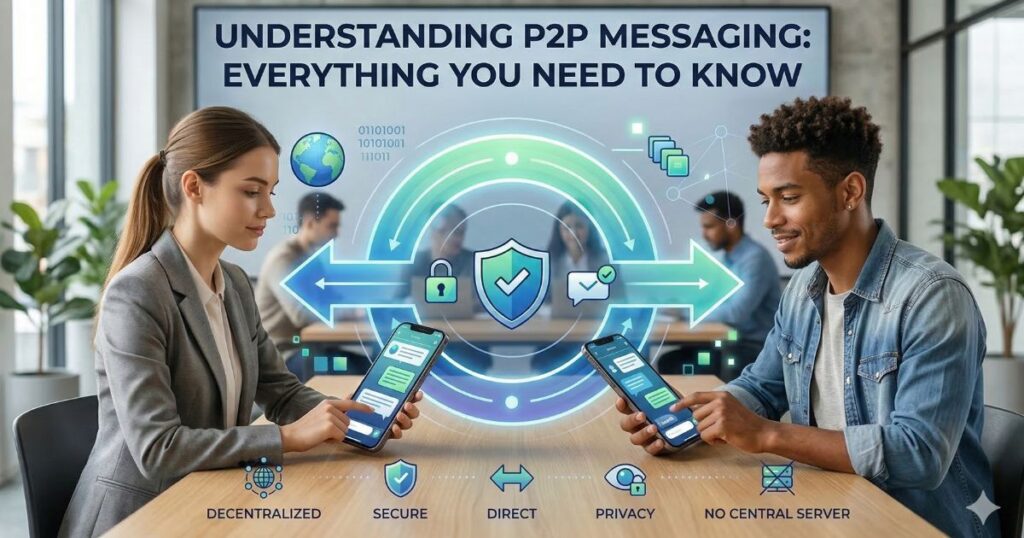
Understanding P2P Messaging: Everything You Need to Know
If the world is powered by data, then it’s not just what you collect, it’s also what and how you communicate that creates real value. As businesses race to optimize customer journeys and support systems, one channel stands out for its trust, simplicity and responsiveness. Person-to-person (P2P) messaging continues to outperform others, especially in marketplaces and customer engagement. What Is P2P Messaging ? P2P messaging refers to direct communication between two mobile service users/ subscribers without automated systems in the flow. It’s most often delivered via SMS (Short Message Service) or chat apps like WhatsApp or iMessage. Each message starts as an MO (Mobile Originated) message when sent from the sender’s device and becomes MT (Mobile Terminated) when received on the recipient’s device. Together, MO and MT form the complete P2P cycle. The Sender ID in this context is typically a long code like a regular 10-digit number representing a real person, not a brand or platform. Unlike A2P systems, where a server sends messages in bulk, P2P messaging is built around individual peer interactions, usually via long codes routed through a user’s home network (the MNO or Mobile Network Operator). Components of P2P Messaging While it looks as the most simplest form of communicating, there are multiple components operating with it under the hood. Advanced networks may use messaging protocols like SMPP (Short Message Peer-to-Peer) to route SMS between SMSC (Short Message Service Centers). However, in traditional P2P, this layer is often invisible to the end user. How does P2P Messaging Work? P2P (Person-to-Person or Peer-to-Peer) messaging is about direct, human conversation. Whether it’s a customer texting a support rep, a buyer reaching out to a seller, or a rider messaging their delivery driver. These are real interactions that shape customer experience and brand perception. Now that we know what’s under the hood, let’s understand the process. 1. Message Composition A user opens their messaging app (such as SMS, WhatsApp, or another chat platform) and composes a message. The sender manually enters the recipient’s phone number or selects a contact from their address book. 2. Message Submission Once composed, the sender hits “send.” The message is transmitted from the sender’s device to their mobile network operator (MNO) or the internet, depending on the platform. 3. Routing Through the Network The mobile network operator (for SMS) or the messaging service provider (for chat apps) receives the message and determines the best route to deliver it to the recipient. For SMS, this involves routing through the appropriate Short Message Service Center (SMSC) and possibly interconnecting with other networks if the recipient is on a different carrier. 4. Delivery to Recipient’s Device The message is delivered to the recipient’s device via their MNO or through the internet if using an over-the-top (OTT) app. The recipient is notified of the new message, typically through a push notification or alert. 5. Read and Response The recipient reads the message and, if desired, composes a reply. The process then repeats, enabling real-time, two-way communication. 6. Optional: Delivery Confirmation Many platforms provide a delivery receipt or read receipt, confirming to the sender that the message has been delivered or read by the recipient. This process of P2P maintains that messaging always remains direct, personal, and conversational with each step requiring genuine human interaction. The method is designed for simplicity and immediacy, making it ideal for authentic, real-time exchanges. How P2P, A2P, and P2A Are Different Feature P2P (Person to Person) A2P (Application to Person) P2A (Person to Application) Sender Human Application or Platform Human Recipient Human Human Application or System Use Case Direct conversations Alerts, OTPs, offers Voting, subscriptions Message Path MO to MT Usually MT only MO only Sender ID Long Code Short Code / Branded ID Long Code / Keyword-based Rules Fewer Strictly regulated Depends on region Understanding these definitions helps businesses avoid misusing grey routes or unofficial channels often used to bypass restrictions. Grey routing may temporarily lower costs but risks non-compliance, poor delivery, and reputation damage. Global Compliance and Local Differences In North America, only handset-to-handset messages over long codes are classified as P2P. Anything passing through a messaging API or sent via platform is automatically A2P, even if conversational in tone. In Europe and parts of Asia, there’s more flexibility. Some systems allow messages sent via APIs to still qualify as P2P if the exchange is genuinely two-way and not commercial in nature. Across markets, delivery receipts (DLRs) help businesses confirm that messages reach the intended device. This is key for time-sensitive support or logistics messages sent via P2P routes. How P2P Messaging Is Used Today P2P messaging is not something invented in the last 1 or 2 years, real-world businesses are already based on P2P messaging channels. These communications rely on long codes, direct routing, and minimal system involvement, making them feel natural and reliable. How Tech Alpha Group Supports P2P Messaging Techalpha Group helps businesses move away from risky P2P messaging practices and adopt secure, scalable A2P messaging solutions. Grey routes used in P2P may reduce short-term costs but expose businesses to compliance issues, failed delivery, and reputational risk. If you’re looking to engage users via messaging, A2P is the better alternative: Techalpha’s A2P platform is built for the best compliance, performance, and long-term growth. FAQs 1). Is P2P messaging legal for business or campaign use? P2P messaging is legal for business or campaign use as long as each message is sent through genuine human intervention. It’s important to comply with regulations like the TCPA and FCC in the U.S., which distinguish between manual and automated messaging. Manual sending helps avoid stricter rules that apply to automated (A2P) messages. 2). What are the main benefits of using P2P messaging? The main benefits of P2P messaging include higher engagement and response rates, often exceeding 90% open rates. It allows for real-time, two-way conversations and personalized interactions at scale. P2P messaging also avoids many restrictions placed on bulk or automated communications, making it effective for direct outreach. 3). How is