
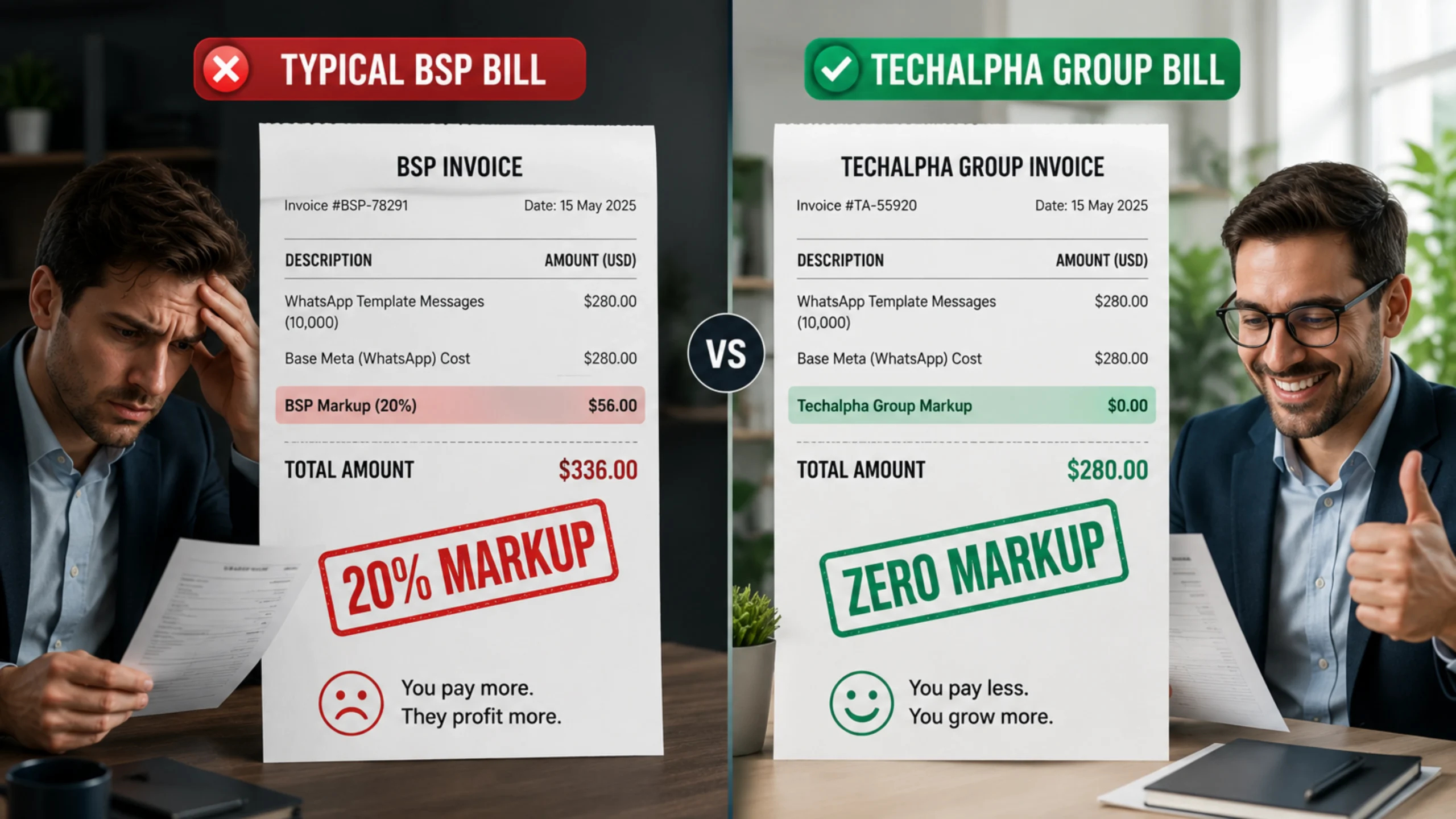
You open your monthly WhatsApp provider invoice expecting a standard, predictable fee, only to be hit with cryptic platform charges and a devastating 30% per-message markup.
You dig into the line items. “Platform Fee.” “Message Markup.” “International Overage.” You are paying a tax on your own growth.
For years, businesses treated WhatsApp like SMS—a simple cost-per-message channel. But going into 2026, Meta’s pricing model is a complex ecosystem of “Template Categories,” “24-Hour Windows,” and “Country Multipliers.” If you don’t understand the physics of this system, you aren’t just paying Meta; you are paying a “Knowledge Tax” to your provider.
Here is the catch: Meta’s base rate is actually quite reasonable. The reason your bill is high is likely because you are misclassifying messages or paying a massive hidden markup to a middleman.
This guide isn’t just a list of rates. It is a strategic playbook designed to help you slash your WhatsApp Business API pricing by up to 30% without sending one fewer message.
Key Takeaways
- The Per-Message Shift: In mid-2025, Meta officially retired “conversation-based” billing. In 2026, you pay strictly per delivered template message.
- The “Free Utility” Hack: As of late 2025, if a customer messages you first (opening a 24-hour service window), sending a Utility template (like an order receipt) within that window is now completely FREE.
- The BSP Trap: Many businesses inflate their WhatsApp Marketing costs India by using providers that secretly add a 15–30% markup on top of Meta’s base messaging rates.
- Authentication Penalties: Meta introduced strict “Authentication-International” pricing. Sending an OTP cross-border can now cost up to 20x more than a domestic OTP, requiring intelligent API routing to avoid bill shock.
WhatsApp Business API Template Classification: Avoiding the "Marketing" Trap
To master the pricing, you have to stop thinking about “Messages” and start thinking about “Intent.” Meta doesn’t charge for text; they charge for context.
Think of it like an airline ticket:
- Marketing (First Class): Expensive. Promotional. Outbound.
- Utility (Economy): Cheap. Transactional. Expected.
- Service (The Lounge): Free. User-initiated.
The Trap: Many businesses send a shipping update (Utility) but include a small “10% off your next order” footer at the bottom of the template.
- Result: Meta’s AI flags the entire message as “Marketing.”
- Cost Impact: When looking at Utility vs Marketing pricing, you just paid up to 8x more for that single message than you needed to.
The 2026 WhatsApp Business API Pricing Guide: Global Category Rates
Let’s look at the raw data for key markets like India, where WhatsApp volume is the highest globally. (Note: Rates are approximate and based on Meta’s January 2026 updates).
1. Marketing Messages (The Budget Eater)
These are your promos, product launches, and abandoned cart nudges.
- India: ~₹0.86 to ₹1.09 per delivered message.
- North America: ~$0.03 to $0.04.
- Germany / UK: ~$0.10 to $0.22 (Massively expensive).
2. Utility Messages (The Workhorse)
These are order confirmations, shipping alerts, and billing statements.
- India: ~₹0.115 to ₹0.145 per message.
- The Reality: Utility messages are roughly 80-90% cheaper than Marketing messages.
3. Authentication Messages (The OTP)
Used exclusively for One-Time Passwords and secure logins.
- India: ~₹0.115 to ₹0.145 per message.
- Volume Tiers: Meta now offers volume discounts for high senders in this category.
4. Service Conversations (The "Free" Hack)
This is the most critical update for 2026. If a user messages you (e.g., “Where is my order?”), a 24-hour window opens.
- Cost: ₹0 / $0.
- Limit: Unlimited. The old “1,000 free conversations” cap is dead. All free-form service replies—and now even Utility templates sent within this window—are completely free.
If you can move your support traffic from SMS (paid) to WhatsApp (free), you instantly reduce your support bill to zero.
Eliminating BSP Markups on WhatsApp Business API Costs
This is the secret most Business Solution Providers (BSPs) won’t tell you.
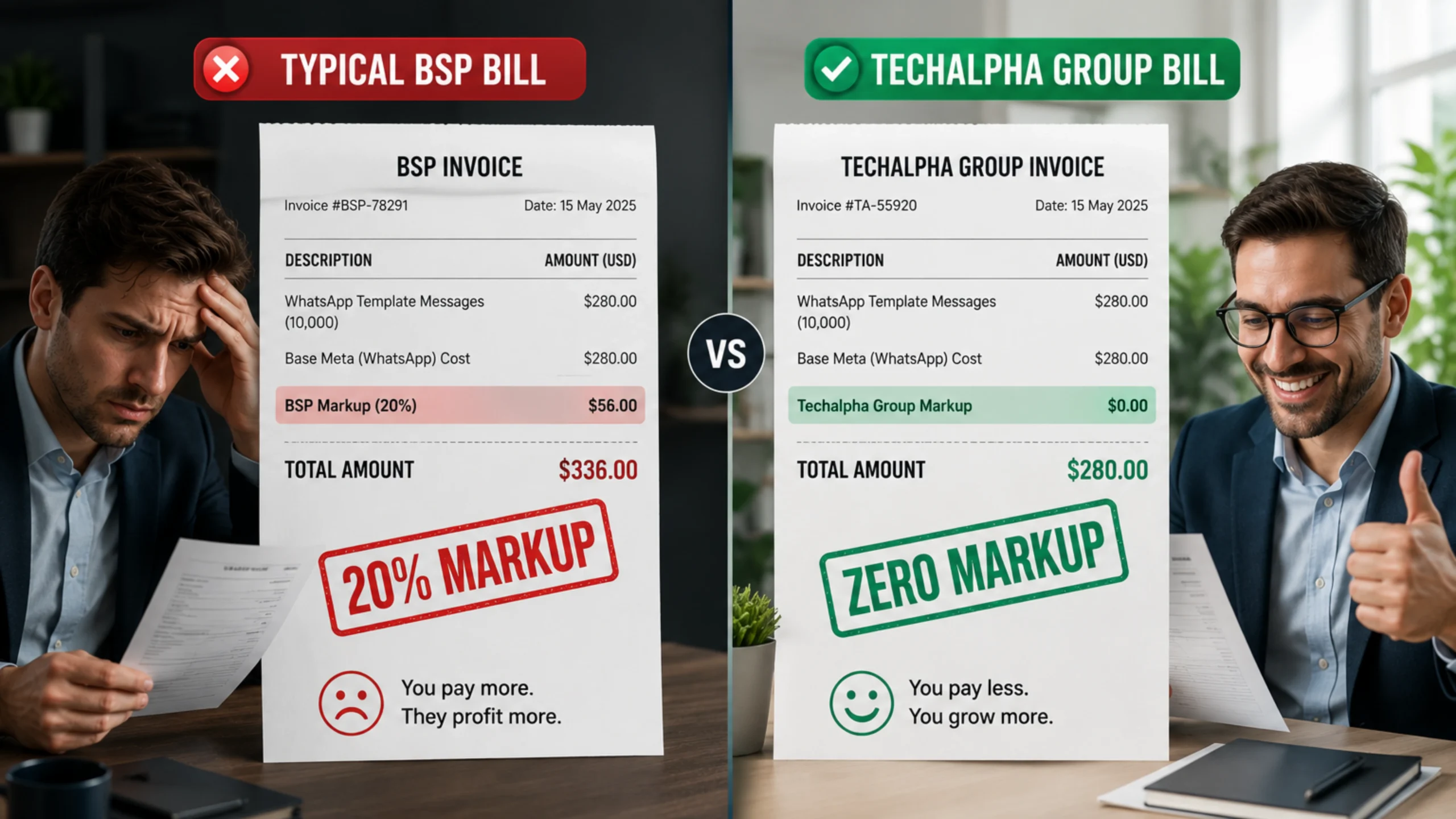
Meta charges a base rate. Let’s say ₹0.86 for a marketing message in India. But your provider bill shows ₹1.05.
Where did that extra ₹0.19 go? The BSP Markup.
Many providers add a 10% to 35% “Processing Fee” on top of every single message. They claim it’s for “infrastructure,” but often, it’s just profit padding. When sending millions of messages, this destroys your ROI.
The Techalpha Difference: Zero Markup
Techalpha Group operates on a transparent Zero Markup BSP model for enterprise clients.
- Meta Charge: ₹0.86
- Techalpha Charge: ₹0.86
- You Pay: A predictable, flat platform fee for the software, not a variable tax on your messaging volume.
E-Commerce WhatsApp ROI Calculator: Evaluating SMS vs. WhatsApp API
Is WhatsApp actually expensive? Let’s use a WhatsApp ROI calculator for an Indian E-commerce brand sending 100,000 messages.
Scenario A: Marketing Blast (100k Users)
- SMS Cost: ₹0.15 × 100,000 = ₹15,000.
- WhatsApp Cost: ₹0.86 × 100,000 = ₹86,000.
- Verdict: SMS is cheaper to send.
- BUT (The ROI): Average SMS Conversion Rate = 0.5%. Average WhatsApp Conversion Rate = 3.0%.
- SMS Sales: 500 sales.
- WhatsApp Sales: 3,000 sales.
- Winner: WhatsApp (by massive revenue margins).
Scenario B: Support / OTPs (100k Users)
- SMS Cost: ₹0.15 × 100,000 = ₹15,000.
- WhatsApp Utility Cost: ₹0.115 × 100,000 = ₹11,500.
- Winner: WhatsApp is cheaper, richer, and more secure.
The Takeaway: Use SMS for low-value, universal fallback. Use WhatsApp for high-value conversions and low-cost utility.
WhatsApp API Compliance: Navigating International OTP Rates and Session Rules
Even with the right pricing model, you can get burned.
1. The "Auth-International" Trap
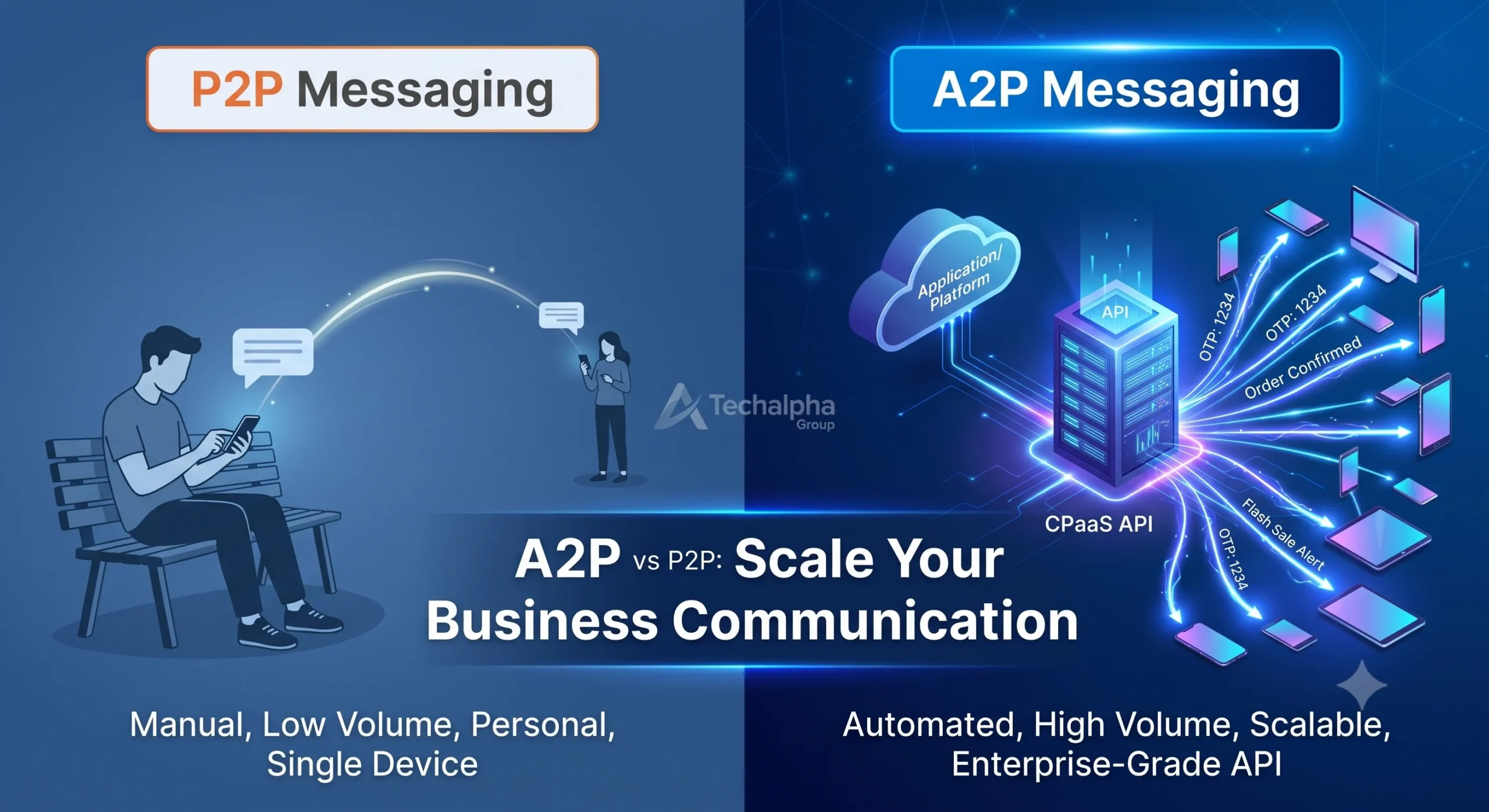
Meta now aggressively splits Authentication (OTPs) into “Domestic” and “International.” If you send an OTP to a user in Pakistan or Indonesia using your standard account, the price can jump by over 10x (often costing over ₹2.30 per message).
- The Fix: Use Techalpha’s “Smart Routing” to dynamically send international OTPs via a cheaper global SMS route, reserving WhatsApp strictly for cost-effective domestic OTPs.
2. The 24-Hour Rule Misunderstanding
“Free Service Window” does NOT mean you can send marketing for free.
- User says: “Hi.” (Window Opens = Free).
- You send: “Here is 50% off!” (Marketing Template).
- Result: You are charged the full Marketing rate. You must use free-form text or Utility templates to keep the interaction free.
Automating Arbitrage with Techalpha’s Intelligent WhatsApp Cost-Router API
You don’t need to manually calculate this every day. You need an intelligent pipe. The Techalpha Group API automates the arbitrage.
- The “Cost-Router” API: Techalpha’s engine checks the message type and destination before sending.
- Logic: “Is this an OTP? Is the destination International? If Yes → Route via SMS. If No → Route via WhatsApp Utility.”
- Template Optimization: Our dashboard pre-validates your templates. If you try to submit a “Utility” message containing promotional keywords, the system warns you: “Risk of Marketing Classification. Remove ‘Discount’ to save 80%.”
- Direct Billing: For large enterprises, Techalpha facilitates Direct Billing with Meta. You pay Meta directly for the messages and pay Techalpha only for the technology infrastructure. This guarantees 100% transparency.
Audit Your Messaging Spend: Deploy a Compliant WhatsApp Infrastructure with Techalpha
WhatsApp Business API pricing is not a fixed cost; it is a variable you can control.
If you treat it like a “dumb pipe,” you will overpay. But if you treat it like a strategic asset—segmenting your Utility traffic, leveraging free Service windows, and removing greedy BSP markups—it becomes the most efficient, high-ROI channel in your tech stack.
Don’t pay the “Ignorance Tax.”