
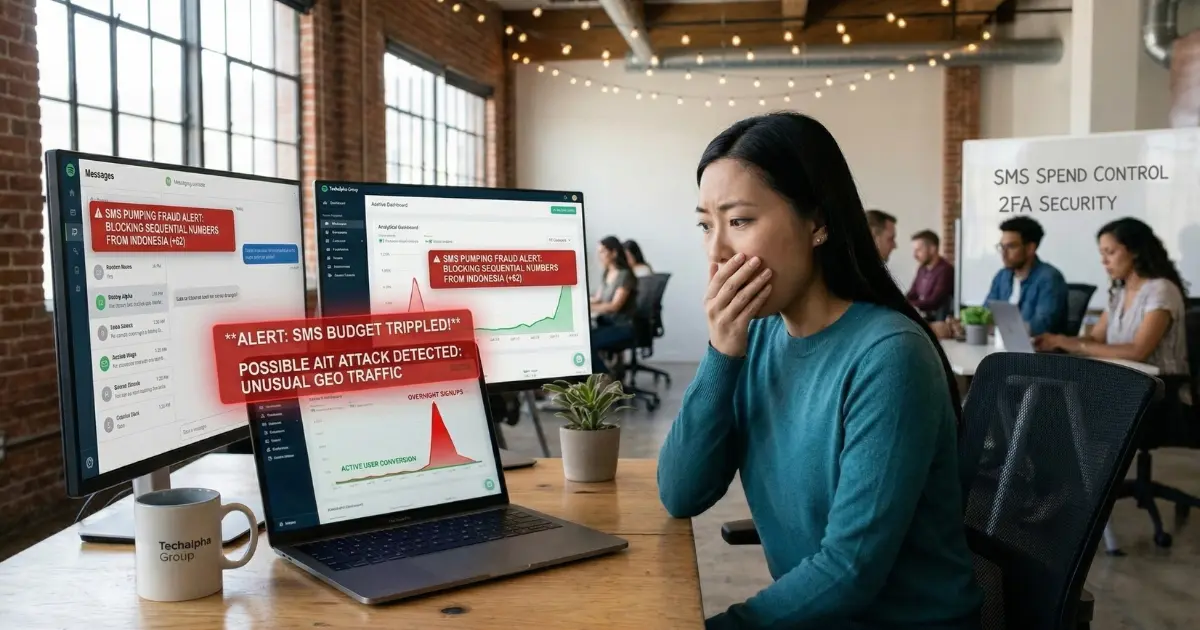
Imagine checking your startup’s dashboard to find a massive spike in user sign-ups overnight, only to realize it’s bot traffic that just completely drained your SMS gateway budget.
In the industry, this is known as SMS Pumping or Artificially Inflated Traffic (AIT). It is not a glitch, and it is not a random attack. It is a sophisticated business model run by cybercriminals who turn your verification system into their personal ATM.
If you have noticed your messaging costs climbing while your conversion rates flatline, you are likely already a victim. This guide is your strategic playbook to stop the bleeding and prevent SMS pumping fraud for good.
Key Takeaways
- Artificially Inflated Traffic (AIT), or SMS pumping, is a sophisticated fraud where bots exploit online forms to trigger OTPs to premium numbers, generating illicit revenue for bad actors in the telecom supply chain.
- This isn’t just a small-business problem; Elon Musk famously revealed that Twitter (now X) was losing $60 million annually to coordinated SMS pumping attacks.
- Global damage from AIT is staggering, costing businesses over $1.15 billion every year due to fake OTP generation alone.
- To stop SMS bot attacks, businesses must implement a multi-layered defense including rate limiting, CAPTCHAs, and strict geographic routing.
- Upgrading to internet-based channels like Verified WhatsApp bypasses the vulnerable legacy SMS billing systems that fraudsters exploit.
The Mechanics of the Scam (Why You Are Paying for Ghosts)
Most founders assume fraud is about stealing user data or credit card numbers. SMS pumping is different; it’s about stealing your infrastructure spend. According to the GSMA, AIT refers to SMS traffic generated explicitly for the fraudulent purpose of creating delivery revenue for certain parties in the traffic chain.
To stop it, you have to understand the flow of money. It relies on a “Revenue Share” loophole in the telecom world.
- The Setup: A fraudster gains control of a block of premium-rate phone numbers, often by colluding with a rogue reseller or a shady aggregator in a high-cost region.
- The Trigger: They point an automated bot army at your app’s “Send OTP” or “Sign Up” button.
- The Attack: The bot requests thousands of SMS verification codes to those specific premium numbers.
- The Payout: You pay your SMS provider for every text sent. The provider pays the carrier. Telecommunications providers often have revenue-sharing agreements with operators of premium rate numbers, meaning the fraudster earns a direct cut of the inflated charges.
You are essentially paying to send messages to ghosts, creating an infinite money glitch where your bank account is the source.
Is Your System Leaking? (The "Red Button" Indicators)
You don’t need a forensic data team to spot OTP Revenue Leakage. You just need to look at your traffic logs with a skeptical eye. If you see these specific patterns, hit the emergency brakes immediately.
1. The "Night Owl" Spike
Look at your timestamp logs. Does your traffic surge at 3:00 AM local time? Unless you just launched a viral campaign, that’s a bot. Real humans sleep; scripts don’t. A sudden wall of traffic during off-peak hours is the clearest sign of an AIT attack.
2. The "Exotic" User Base
Check the country codes. If you are a delivery app in New York, why are you sending 5,000 OTPs to Indonesia (+62) or Latvia (+371)? Fraudsters deliberately use numbers from countries with high termination rates (cost per SMS) to maximize their payout.
3. The Sequential Telltale
Real phone numbers are random. Fraudulent numbers often come in clean blocks.
- Real: +1 … 592, +1 … 104, +1 … 883
- Fraud: +1 … 001, +1 … 002, +1 … 003
Bots are lazy; they iterate through number lists sequentially. If you see adjacent numbers in your logs, you are being pumped.
The "Defense Shield" Strategy (3 Layers of Protection)
To effectively prevent SMS pumping fraud, you cannot rely on a single feature. You need a defense-in-depth approach that adds friction for bots without annoying humans.
Layer 1: The Friction Barrier (User Interface)
Make it harder for a script to push the button.
- Integrate CAPTCHA: Incorporate CAPTCHA challenges on forms to deter automated scripts; invisible CAPTCHA (like reCAPTCHA v3) works best as it doesn’t disturb real users.
- Rate Limiting: Implementing rate limiting controls the number of requests a user or IP can make within a specific timeframe, protecting your system from excessive SMS-triggering requests.
Layer 2: The Logic Gate (Backend Verification)
- Geo-Fencing: Limit your messaging reach exclusively to the countries where your company does business. If you don’t sell there, don’t set up routing to those high-risk markets.
- Header Enrichment: Technologies like Silent Network Authentication verify the user’s device identity in the background. With no SMS generated, the fraud mechanism is bypassed entirely.
Layer 3: The "Kill Switch" (Monitoring)
- Cost Caps: Set a hard daily limit on your SMS spend at the provider level. If your average bill is $50/day, set a cap at $75. If an attack happens, the system shuts down before you lose thousands.
Why WhatsApp is the "Nuclear Option" Against Fraud
If you want to stop playing cat-and-mouse with SMS bots, change the game entirely.
Switching to Verified WhatsApp is one of the most effective ways to eliminate pumping. Why? Because the economics don’t work for fraudsters.
- Pricing Structure: WhatsApp charges based on 24-hour conversation windows, not per segment.
- Route Security: It is end-to-end encrypted, strictly regulated by Meta, and tied to internet connectivity rather than legacy telecom routing tables.
Fraudsters cannot easily monetize WhatsApp traffic the way they can with SMS termination fees. It completely breaks their business model.
Securing Your Future with the Right Partner
Fighting this alone is a losing battle. Bots evolve, using residential proxies to hide their IPs and sophisticated browsers to mimic human behavior.
Fortunately, the industry is fighting back. Juniper Research forecasts that consumer losses to mobile messaging fraud will drop to $71 billion globally in 2026, driven largely by enhanced, AI-driven firewall capabilities. You need an infrastructure partner equipped with these modern firewalls to filter traffic before it hits your bill.
This is where Techalpha Group steps in. We provide robust Enterprise Messaging Security:
- AI-Driven Detection: Our proprietary system analyzes traffic patterns in real-time. If it detects a “pumping” pattern, it blocks the request instantly.
- Pre-Send Validation: We verify if a number is active and valid before attempting to send the SMS, saving you the cost of failed messages.
The Bottom Line SMS Pumping Fraud is a tax on your growth. Every dollar you spend on a bot is a dollar you can’t spend on acquiring a real customer.
By implementing smart UI friction, backend logic, and partnering with a security-first CPaaS provider, you can close the back door and secure your budget.