
You found a budget SMS provider charging just fractions of a cent per message. You launch your campaign, only to be flooded with support tickets from users who never received their critical alerts.
“I didn’t get my login code.” “Why did I get a text from a random number instead of your brand?” “My alert arrived 2 hours late.”
You check your dashboard. It says “Sent.” You check your server logs. Everything looks fine. But in the real world, your users are churning, and your brand reputation is taking a beating.
Here is the catch: You didn’t buy a reliable SMS service; you bought a Grey Route.
In the telecom world, there is no such thing as a “free lunch.” If an SMS price looks too good to be true, it is because the provider is cutting corners on the infrastructure. They are routing your critical business messages through a maze of unregulated, low-quality networks to avoid paying official carrier fees.
Enter Direct carrier routes for Bulk SMS.
This is the “Business Class” of messaging. It is the infrastructure used by banks, governments, and enterprise unicorns. It guarantees that when you hit “Send,” the message travels directly to the operator (like Verizon or Jio) without detours.
This guide explores the dirty underbelly of SMS routing, why “Hops” kill deliverability, and why paying a premium for a Tier 1 SMS Gateway is actually the cheapest option in the long run.
Key Takeaways
- The Grey Route Epidemic: In 2026, over 40% of global A2P SMS traffic is still routed through vulnerable, multi-hop “Grey Routes” to bypass carrier termination fees, resulting in massive delivery failures.
- Regulatory Crackdown: Carriers and regulators (like the FCC in the US and TRAI in India) are actively hunting and blocking Grey Route traffic. Using these routes puts your brand at risk of permanent domain or sender ID blacklisting.
- The Latency Trap: Every “hop” an SMS takes between aggregators adds latency. Zero-Hop SMS via direct carrier connections ensures sub-5-second OTP delivery.
- Fake Delivery Receipts: Cheap aggregators often fake Delivery Receipts (DLRs) to make their dashboards look successful while silently dropping your messages to save money.
- The White Route Advantage: True High Deliverability SMS relies on strict SMPP Connectivity directly to Tier 1 operators, preserving your custom Sender ID and guaranteeing compliance.
Understanding Enterprise SMS Routing: Why Deliverability Matters
To understand why routing matters, stop thinking about data packets and start thinking about air travel.
Imagine you need to fly from New York to London for a critical meeting.
- The Direct Route (Tier 1): You buy a direct ticket. You take off in New York. You land in London 7 hours later.
- Cost: Higher.
- Reliability: 99.9%.
- The Grey Route (Tier 2/3): You buy a ticket for $50. But there’s a catch. You fly from New York to Iceland. You switch to a budget airline flying to Morocco. You take a bus to a ferry. Then you fly to a small airport 50 miles outside London.
- Cost: Dirt cheap.
- Reliability: Terrible. You might get stuck in Morocco, or your luggage (the message content) might get lost.
Why does this matter? For marketing blasts, maybe you don’t care if the message arrives 10 minutes late. But for OTPs or Transaction Alerts, a delay of even 30 seconds is a failure.
Direct carrier routes for Bulk SMS ensure your message takes the direct flight. No layovers. No lost luggage.
The Anatomy of a Route (White vs. Grey)
Let’s get technical. What actually happens in the wires when comparing Grey Routes vs White Routes?
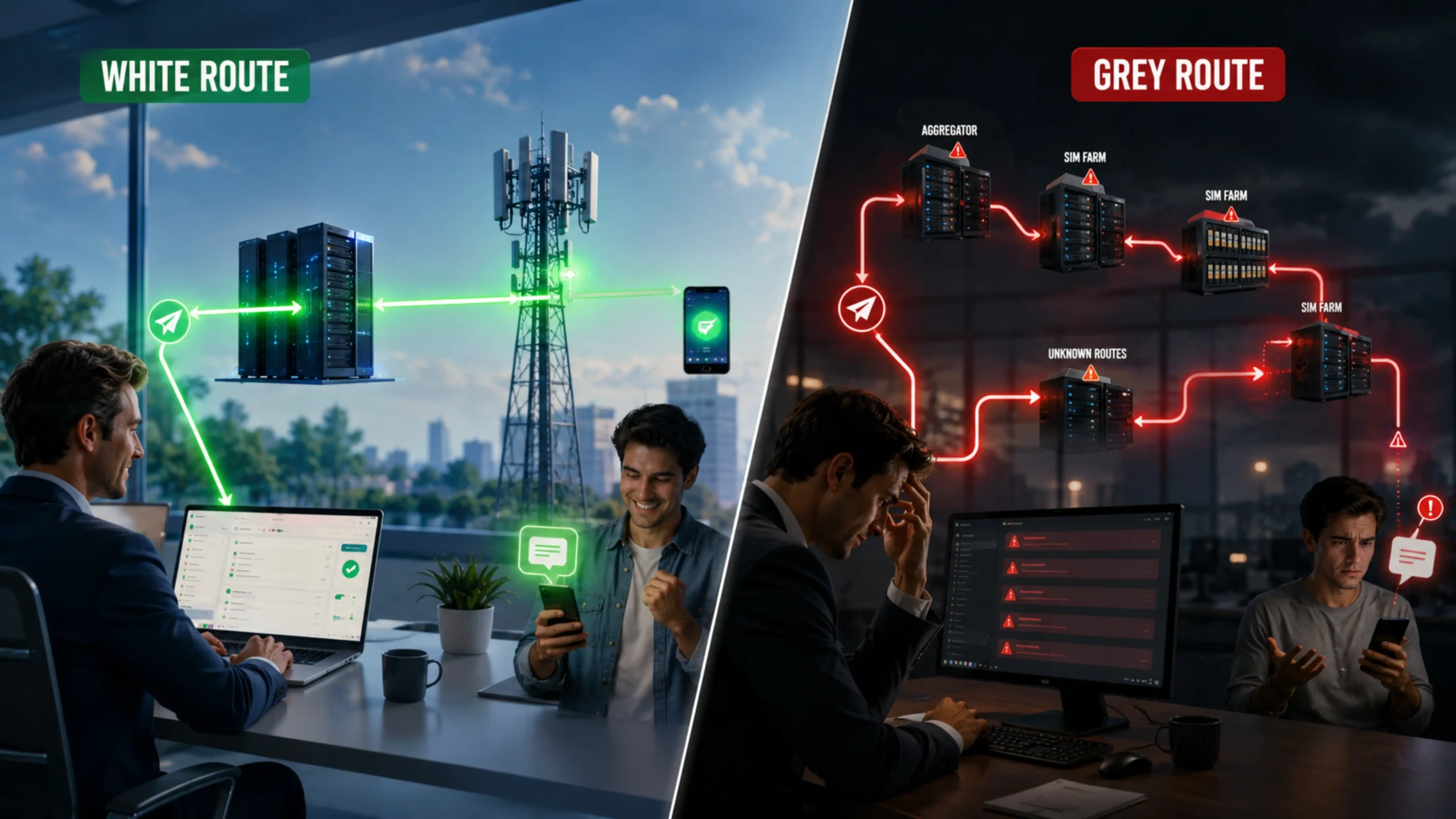
1. The White Route (Direct / Tier 1)
- Architecture: Zero Hops.
- Flow: Your Server → Techalpha Gateway → Mobile Carrier (MNO) → User Device.
- Sender ID Preservation: If you send as “Nike,” it arrives as “Nike.” The route honors alphanumeric headers.
- Delivery Receipts (DLR): True visibility. The carrier confirms exactly when the handset received the message.
- Speed: Guaranteed sub-5 seconds.
2. The Grey Route (Sim Farms / Hop-Heavy)
- Architecture: Multiple Hops (often exploiting network vulnerabilities).
- Flow: Your Server → Cheap Aggregator → International Carrier (e.g., routing US traffic through Nigeria) → Local Carrier → User Device.
- The Scam: Aggregators try to trick the local operator into treating commercial A2P traffic as cheaper P2P (Person-to-Person) or “Roaming” traffic to avoid official termination fees.
- The Consequence: Your brand name is stripped and replaced by a random long code (e.g., +44 789…). Furthermore, if carriers detect this blending, they “Silent Drop” the traffic. Your messages simply vanish.
Why Direct Routes Are Critical for 2026
The telecom landscape has fundamentally changed. It is no longer the Wild West.
1. The Compliance Firewall
Carriers have implemented strict firewalls (like 10DLC in the US and DLT in India) to block unverified traffic.
- Direct Routes: Fully compliant. Your templates and headers are officially whitelisted on the carrier switch.
- Grey Routes: Rely on “blending” your OTPs with spam traffic to hide. When the spam gets blocked by the firewall, your critical OTPs get blocked too.
2. The Latency Imperative
We live in an instant gratification economy.
- OTP Latency on Direct Route: 2-4 seconds.
- OTP Latency on Grey Route: 15-60+ seconds (or total timeouts).
If your user clicks “Resend OTP” because the first one was slow, you pay for two messages, and the user is frustrated. High latency equals high churn.
3. Two-Way Reliability
Modern retail relies on 2-way SMS (“Reply Y to confirm”). Grey routes often use “SIM Farms”—banks of physical consumer SIM cards plugged into a server. These SIMs cannot reliably handle reply routing. If a user replies, it goes to a burner phone in a basement, not to your software webhook.
The Execution (How to Spot a Fake)
How do you know if your provider is selling you a Tier 1 SMS Gateway or a cheap fake? They won’t tell you. You have to test it.
Test 1: The Sender ID Test
- Expected: Sender is “BRANDNAME”.
- Reality: Sender is a random 10-digit number.
- Diagnosis: Grey Route. The route couldn’t pass the alphanumeric header, so the downstream carrier overwrote it to bypass A2P filters.
Test 2: The DLR (Delivery Receipt) Test The “Fake DLR” Scam is rampant. Shady providers send back a “Delivered” status immediately, even if they dropped the message to save money.
- How to catch it: Buy a burner phone. Keep it turned off. Send an SMS to it.
- Direct Route: Your logs will show the status as “Buffered” or “Retrying.”
- Fake Route: Your logs will show “Delivered” (which is impossible, since the phone is offline).
The Techalpha Advantage: Zero-Hop Enterprise SMS Infrastructure
This is where Techalpha Group stakes its reputation. Most aggregators compete on price. We compete on A2P Messaging Quality and Physics.
We operate a strict Zero-Hop SMS infrastructure.
1. Direct SMPP Binds
Techalpha doesn’t use intermediate aggregators for major markets. We maintain direct, physical SMPP Connectivity to the switches of major telcos. You aren’t sharing bandwidth with cheap marketing spam.
2. Intelligent Fallback
Even direct routes experience hardware failures (fiber cuts, data center outages). Techalpha’s API monitors the “Pulse” of the direct connection.
- Scenario: Route A (Direct to Vodafone) shows a 1% latency spike.
- Action: We automatically reroute traffic to Route B (Direct to Airtel Interconnect) instantly. You pay for absolute reliability.
3. Transparent Pricing
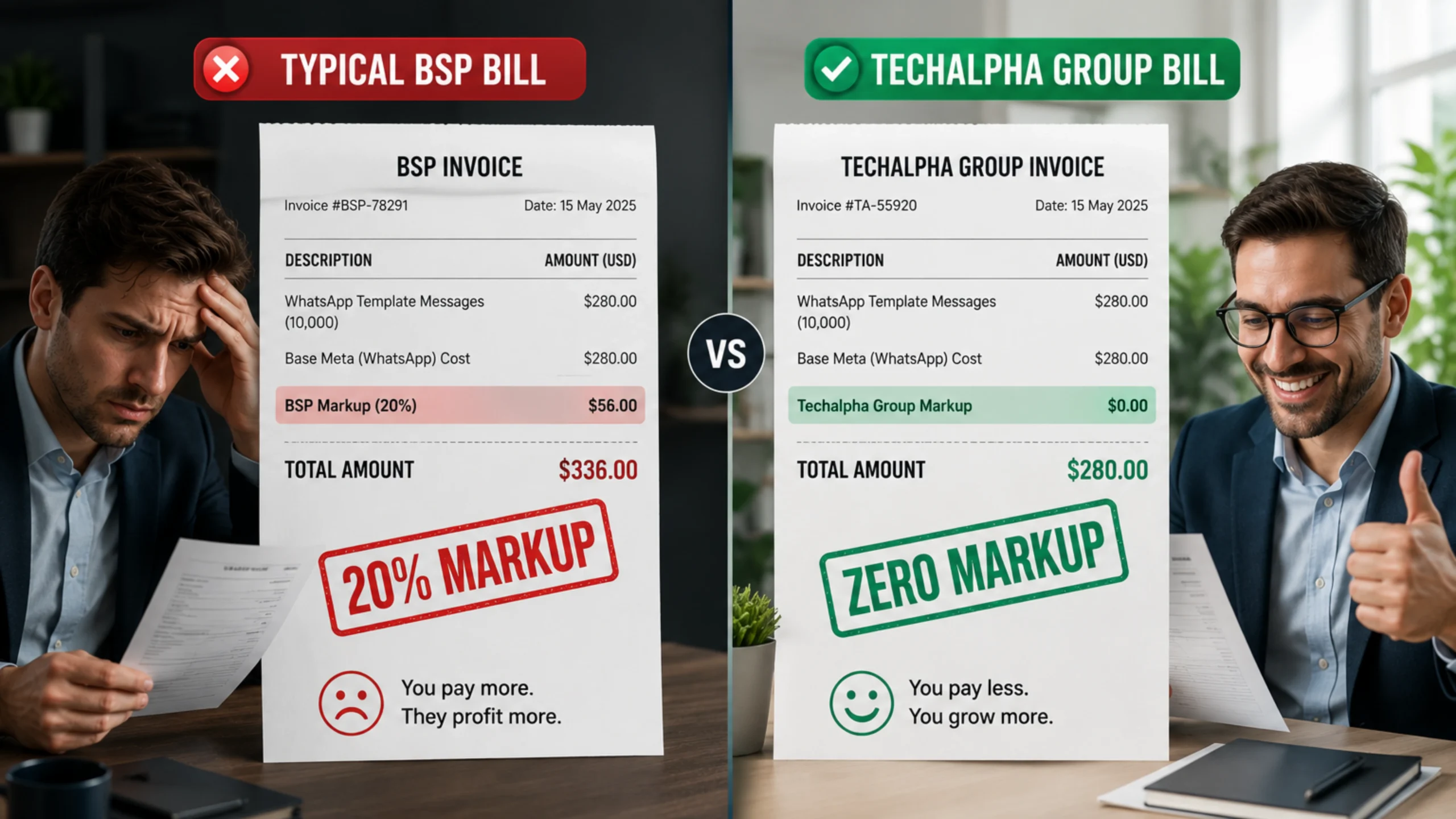
Techalpha will never be the absolute cheapest option on the market. Direct routes cost money because Tier 1 carriers charge official termination fees.
If a competitor offers you a price lower than the carrier’s base surcharge, run away. They are selling you a Grey Route. Techalpha offers transparent pricing—you pay exactly what the carrier charges plus a small, transparent technology fee.
The True Cost of Cheap SMS: Why Startups Need Tier-1 Routing
Cheap SMS is the most expensive mistake a startup can make.
Saving $0.01 on an SMS is meaningless if that SMS was supposed to verify a $1,000 transaction. When that message fails, you lose the user, the revenue, and the trust.
Direct carrier routes for Bulk SMS are insurance. They ensure that your infrastructure works as hard as you do. Don’t build your business on a house of cards. Build it on direct fiber.