
In the modern omnichannel ecosystem, how a business communicates is just as important as what it says. As enterprises scale their customer engagement strategies, they inevitably encounter two distinct telecommunications acronyms: A2P (Application-to-Person) and P2P (Person-to-Person) messaging.
While both deliver messages to a mobile device, their architecture, compliance regulations, throughput speeds, and business applications are fundamentally different. Using the wrong infrastructure can lead to blocked messages, compliance fines, and damaged brand reputation.
In this definitive guide, we’ll break down everything you need to know about A2P vs P2P messaging, the channels they operate on, and how to choose the right infrastructure for your enterprise.
What is A2P Messaging (Application-to-Person)?
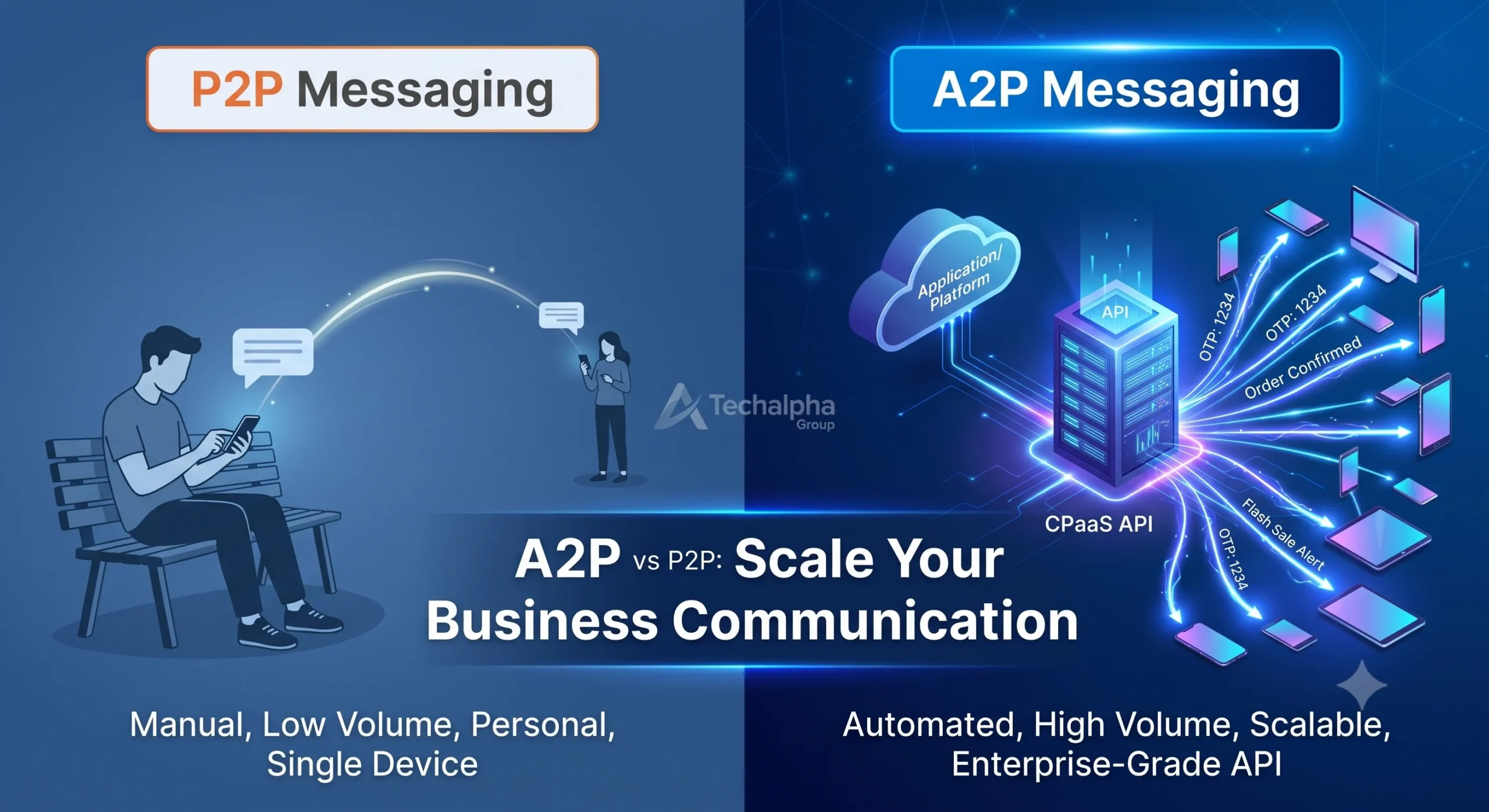
A2P (Application-to-Person) messaging occurs when an application, software, or API sends a message to a human user. Because these messages are generated programmatically, A2P is the undisputed standard for commercial and enterprise communication.
Whenever you receive a bank alert, a marketing promotion, an Uber arrival notification, or an OTP (One-Time Password) for two-factor authentication, you are experiencing A2P messaging.
Key Benefits of A2P Messaging for Enterprise
High Throughput & Scalability: A2P APIs can process and deliver thousands of messages per second.
Automation: Integrates directly into your CRM, marketing platforms, or proprietary software via APIs.
Advanced Analytics: Offers granular delivery receipts (DLR), open rates, and click-through metrics.
Sender Identification: Allows for alphanumeric Sender IDs or Verified WhatsApp Green Ticks, ensuring brand trust.
Common A2P Messaging Channels
A2P is not limited to traditional SMS. Today’s commercial routing utilizes a true omnichannel approach:
- A2P SMS & MMS: Standard text and media messaging.
- Verified WhatsApp Business API: Rich media, two-way conversational commerce.
- RCS (Rich Communication Services): Interactive buttons, verified sender branding, and high-res media.
- Voice / OBD IVR: Automated voice blasts and interactive voice response.
Understanding P2P Messaging (Person-to-Person)
P2P (Person-to-Person) messaging is exactly what it sounds like: a two-way conversation between two human beings using their mobile phones. When you text a friend, family member, or colleague from your personal device, you are using P2P routing.
The Limitations of P2P for Business
Historically, small businesses used P2P networks (like standard mobile SIM cards) to text customers. However, global telecom regulators strictly prohibit using P2P routes for commercial traffic.
- Low Volume Restrictions: P2P networks limit throughput (usually 1 message per second). Sending bulk texts via P2P will trigger carrier spam filters.
- No Automation: Requires manual typing and sending.
- Lack of Compliance: Using P2P for marketing violates global telecom regulations (like DLT in India or 10DLC in the US).
A2P vs P2P Messaging: Key Differences at a Glance
To simplify the technical differences, here is how the two frameworks compare:
| Feature | A2P (Application-to-Person) | P2P (Person-to-Person) |
|---|---|---|
| Primary Sender | Software / Application / API | Human / Mobile Phone |
| Volume & Speed | High volume, thousands of MPS (Messages Per Second) | Low volume, roughly 1 MPS |
| Typical Use Case | OTPs, Marketing Blasts, Alerts, Automated Reminders | Personal chats, 1-on-1 human conversations |
| Sender Identity | Custom Alphanumeric Sender ID, Shortcodes, Verified Numbers | Standard 10-digit mobile number |
| Compliance | Heavily regulated (Requires Opt-ins, DLT, 10DLC registration) | Standard carrier terms of service |
| Business Fit | Enterprise, SaaS, E-commerce, FinTech | Personal use only |
Why A2P is the Non-Negotiable Standard for 2026
As telecommunication networks deploy stricter spam firewalls powered by AI, relying on P2P routes for business communication is a critical operational risk.
Transitioning to a robust A2P architecture like the infrastructure provided by Techalpha Group ensures your business achieves:
- Direct Carrier Routing: Eliminating “grey routes” to ensure your critical OTPs and transactional alerts reach the handset instantly.
- Regulatory Compliance: Built-in adherence to localized telecom laws, protecting your brand from heavy fines or blacklisting.
- Omnichannel Fallback: If an A2P WhatsApp message fails to deliver, the API can automatically fall back to an A2P SMS, guaranteeing delivery.
Final Thoughts: Choosing the Right API Provider
Understanding the difference between A2P and P2P messaging is just the first step. The real competitive advantage comes from partnering with a CPaaS (Communications Platform as a Service) provider that offers low latency, deep analytics, and dedicated carrier routes.
Whether you are sending automated shipping updates via WhatsApp or bulk promotional SMS campaigns, upgrading your A2P infrastructure is the key to unlocking scalable customer engagement.
Techalpha Group provides enterprise-grade A2P messaging APIs designed for high-conversion omnichannel engagement. Connect with our telecom architects today to build your bespoke messaging strategy.