
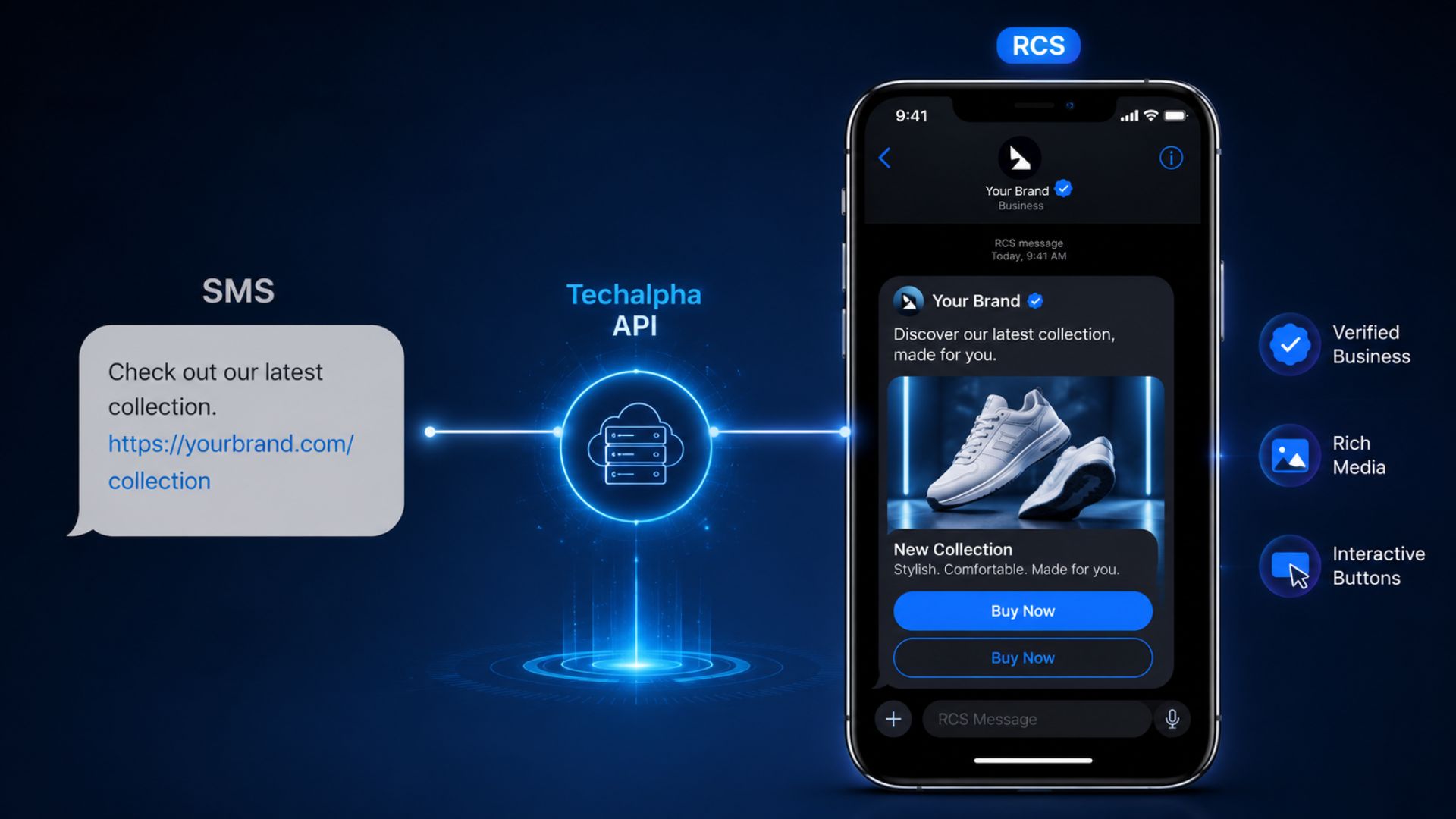
You spend thousands of dollars designing a beautiful, interactive marketing campaign, only to watch it fracture upon delivery. Android users see a stunning carousel with high-res images and a “Buy Now” button. iPhone users receive a grainy MMS or a plain text link that looks like spam.
For the last decade, marketers have been forced to play a game of “lowest common denominator.” Because over 50% of the US market (iPhone users) couldn’t receive Rich Communication Services (RCS), brands had to scale back their campaigns to plain SMS.
With the rollout of iOS 18, Apple has officially adopted the Apple RCS Universal Profile. This adoption upgrades the traditional “green bubble” from a text-only, unverified message into a premium, interactive channel.
This guide outlines the infrastructure changes behind RCS business messaging iOS availability in 2026, the impact on your customer retention metrics, and how to successfully deploy rich messaging to iOS users today.
Executive Summary: The iOS 18 RCS Landscape
- The RBM Unlock: While P2P RCS launched with iOS 18.0, Apple officially unlocked Application-to-Person (A2P) iOS 18 RBM support starting with iOS 18.1, enabling enterprise brand adoption.
- Market Growth: Following Apple’s adoption, global RCS Business Messaging traffic surged 5x, with North American traffic scaling rapidly by 14x.
- Verified Identity: The Verified Sender iPhone update replaces random 5-digit short codes with an official brand name, logo, and a verified checkmark directly inside the native Messages app.
- Feature Parity: iPhones now support rich carousels, suggested action buttons, high-resolution media sharing, and read receipts natively over cellular data.
- Intelligent Fallback: Because some older devices or regional carriers lack support, utilizing an orchestration layer like the Techalpha Group API is critical to ensure messages seamlessly downgrade to SMS when necessary.
The Technical Foundation: Bridging iOS and Android
To understand the scope of this update, it helps to look at the underlying protocols. Historically, the mobile ecosystem relied on fragmented messaging languages:
- iMessage: Apple’s proprietary, closed-ecosystem protocol.
- RCS: The GSMA industry standard supported globally by Android.
- SMS: The legacy protocol utilized to bridge cross-platform communication.
The iOS 18 update acts as a universal translator. Apple integrated the GSMA’s RCS industry standard, meaning enterprises can now push a single rich message payload via an API. Whether the payload lands on a Samsung Galaxy S25 or an iPhone 16, it renders natively as an interactive RCS message, eliminating the need to design fragmented cross-platform campaigns.
The End-User Experience: Visualizing RCS on iOS Devices
Understanding the end-user interface is critical for marketing and product teams. Here is how RCS business messaging iOS availability materializes on the iPhone in 2026.
1. Delivering Verified Brand Trust
This is the most critical feature for security and conversion optimization.
- Legacy SMS: Displays a random short code (e.g., 55-021), offering no visual proof of identity.
- RCS on iOS: The Verified Sender iPhone display places your exact Brand Name, your Logo, and a Verified Checkmark at the top of the chat. Users immediately recognize authentic communications from trusted brands.
2. Achieving Cross-Platform Feature Parity
The interactive experience on iOS is now nearly identical to Android devices:
- High-Res Media: Supports uncompressed images and high-fidelity video sharing.
- Engagement Tracking: Natively supports read receipts for accurate open-rate tracking.
- Interactive UI: “Suggested Actions” and “Rich Cards” execute natively, allowing users to browse products or confirm appointments without leaving the messaging app.
Stop Sending Plain Text. Start Sending Experiences. Upgrade your omnichannel strategy with Techalpha Group’s RCS API. Reach 100% of smartphones with intelligent fallback routing.
Unifying Omnichannel Campaigns in the RCS Era
Before iOS 18.1, RCS required heavy audience segmentation. In 2026, RCS operates as the baseline standard for mobile engagement.
The Modern Campaign Workflow:
- Unified Audience Targeting: Teams no longer need to segment audiences by Operating System.
- Rich-Media First Design: Design the optimal experience first—utilize carousels, high-res video, and deep links.
- Automated Fallback: Rely on your CPaaS infrastructure to automatically downgrade the message to SMS for the single-digit percentage of users on unsupported networks.
Driving Campaign ROI: When evaluating RCS vs SMS marketing, RCS fundamentally alters the billing structure. RCS pricing is session-based (billed per 24-hour window) rather than segment-based (billed per 160 characters). Data from early enterprise adopters demonstrates that RCS on the iPhone drives 40% to 60% higher engagement rates compared to legacy SMS text links.
Implementation Challenges and Security Considerations
While the Apple rollout is transformative, enterprises must account for a few infrastructural realities during the transition.
1. Navigating Carrier Rollouts
Support for the iPhone’s RCS software depends on the local carrier network. While Tier-1 global carriers support iOS 18 RBM support seamlessly, smaller MVNOs (budget networks) may face delays in their rollout. Enterprises must utilize an API with robust fallback logic rather than assuming immediate 100% network compatibility.
2. Evaluating Encryption Standards
Apple launched with RCS Universal Profile 2.4, which features in-transit encryption. Full End-to-End Encryption (E2EE) via Universal Profile 3.0 (utilizing the MLS protocol) is slated for future iOS software updates.
3. User Opt-Outs and Preferences
Apple allows users to manually disable “RCS Business Messages” within their device settings. To ensure deliverability to users who opt out, it is imperative to maintain compelling SMS fallback copy within your API payload.
Streamlining RCS Delivery with the Techalpha Group API
Building complex “If/Else” routing logic for thousands of device and carrier combinations drains engineering resources. The Techalpha Group API handles this orchestration natively.
Intelligent Capability Routing:
- Device Ping: The API silently queries the device capabilities and carrier status prior to transmission.
- Optimized Routing: If the network confirms “User is on iOS 18.1+ AND Carrier Supports RBM,” the API delivers the rich RCS payload.
- Seamless Fallback: If the capability check fails, the API automatically strips the rich media and delivers a high-quality SMS format with a tracked short-link.
Scaling Your Communications Strategy
The integration of the Apple RCS Universal Profile represents a structural shift in enterprise mobile messaging. RCS business messaging iOS availability effectively doubles the addressable market for verified, interactive brand communications.
You no longer have to choose between the reach of SMS and the immersive experience of RCS.